A prudent person in the conduct of competitive business would incur this cost. The amount does not exceed what a reasonable person would pay. Nature and amount are consistent with sound business practices.
The cost is assignable to one or more cost objectives (contracts, pools) based on relative benefits received. A cost is allocable if it benefits the contract, is necessary for overall operations, or is specifically required by the contract.
The cost is treated consistently with Cost Accounting Standards (CAS) and Generally Accepted Accounting Principles (GAAP). Consistency in estimating, accumulating, and reporting costs is mandatory.
The cost is not prohibited by the specific terms or conditions of the contract. Limitations or exclusions in the contract take precedence over general FAR cost principles.
Even if a cost passes all four tests above, FAR 31.205 can still render it unallowable. The 52 subsections of FAR 31.205 define specific cost categories and whether they are expressly unallowable, conditionally allowable, or generally allowable. When in doubt, check the specific subsection.
Amusement, diversions, social activities, and related costs. Includes tickets, hospitality suites, meals with no bona fide business purpose, and recreational events for employees or clients.
All costs of alcoholic beverages are unallowable. No exceptions. This includes beverages at business meals, company events, or any other occasion regardless of business purpose.
Charitable contributions, donations, and gifts to any organization or individual. Includes sponsorships of charitable events, in-kind donations, and matching gift programs.
Fines, penalties, and late payment charges imposed by federal, state, local, or foreign governments. Includes parking tickets, tax penalties, and regulatory fines.
Costs of lobbying, political contributions, PAC activities, and efforts to influence legislation or executive orders. Includes state and local lobbying.
Losses from uncollectible receivables and bad debt write-offs. These are business risks unrelated to contract performance and are expressly unallowable.
Any amortization of goodwill arising from business combinations. Excess of purchase price over fair value of tangible assets is unallowable regardless of accounting treatment.
Interest on borrowings, bond discount amortization, finance charges, and the cost of financing capital. Exception: CAS 414 Facilities Capital Cost of Money is specifically allowed.
Costs of general economic planning not related to specific contracts or cost objectives. Broad market studies and economic forecasting outside contract scope.
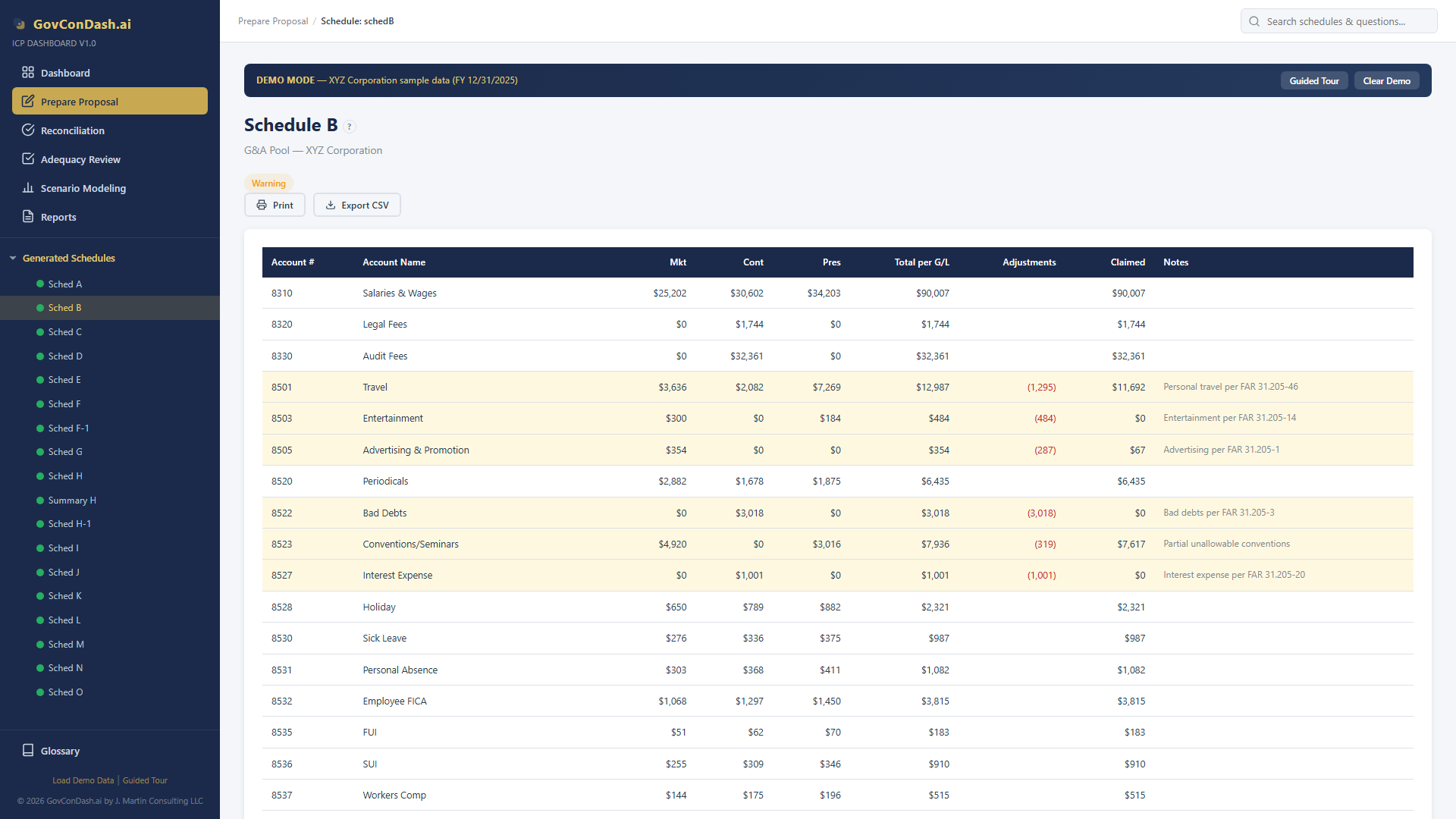
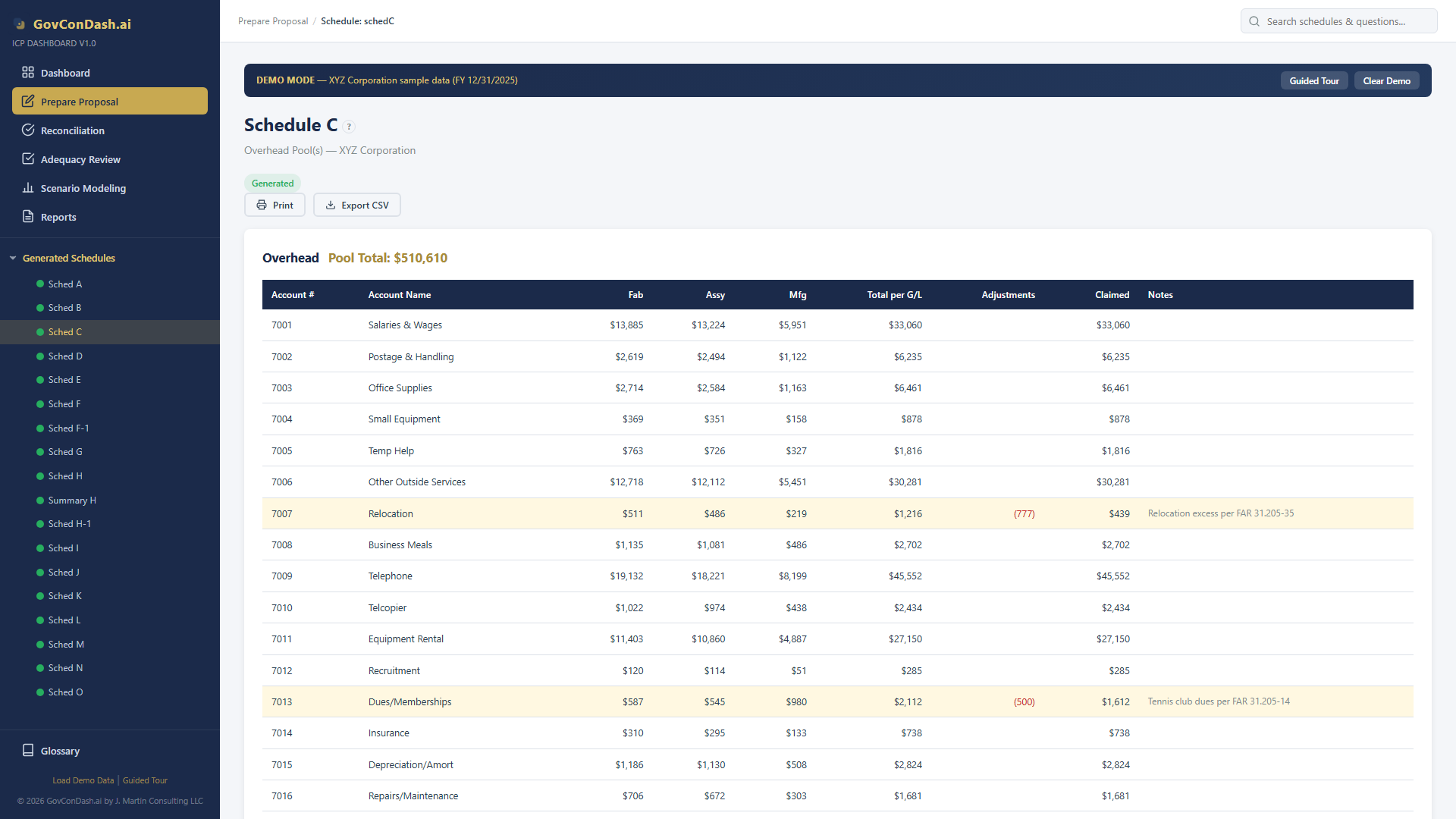
Having unallowable costs in your general ledger is not a problem — every contractor has them. The issue is failing to adjust them out before claiming. Your Schedule B (G&A) and Schedule C (OH) must show adjustments that reduce the claimed amount to zero for these categories. The ICP Dashboard's Smart Validation Engine detects these automatically and verifies your adjustments.
Excess executive compensation, distribution of profits as additional pay, unreasonable compensation amounts, stock-based compensation (stock options, restricted stock, SARs), severance pay exceeding normal patterns, foreign national severance, and back pay awards.
Unfunded pension accruals, failure to fund within required period (6 months after FY end), segment closing gains/losses, pension asset withdrawals (reversions), plan curtailment costs, ERISA termination adjustments, PBGC premium allocations, and early retirement incentives exceeding 2x normal cost.
Deferred compensation not vested within 12 months of earning, ESOP leveraged buyout allocations, ESOP stock purchases above market value, post-retirement benefit (PRB) costs not compliant with CAS 416, and special compensation limitations.
Self-insurance reserves exceeding actuarial estimates, key-person life insurance costs, property coverage beyond replacement cost, nuclear liability insurance premiums, and insurance for activities that are themselves expressly unallowable.
Entertainment costs (zero exceptions), alcoholic beverages (zero tolerance), bad debts and write-offs, goodwill amortization from acquisitions, charitable contributions and donations, and general economic planning costs unrelated to contracts.
Interest on borrowings (all forms), bond discount and premium amortization, financing charges, and contingency provisions for anticipated penalties or fines. Exception: CAS 414 Facilities Capital Cost of Money is specifically allowed.
Depreciation exceeding asset fair value, idle facility maintenance and repair costs, idle capacity costs above normal operating range, plant reconversion costs, rental costs exceeding fair market value, and lease-purchase arrangements treated as purchases.
Public relations advertising, lobbying and political activities (all forms), organization and M&A costs, selling costs to non-government customers, legal defense of fraud proceedings, tax exemptions not passed through, trade show costs for promotion, and excessive professional service fees.
Government-owned equipment leasing costs (DFARS), additional compensation limits for DoD contracts, DoD lobbying prohibitions, restructuring costs exceeding projected savings, independent research (DFARS cap). Plus: employee morale entertainment, relocation home acquisition costs exceeding limits, first-class travel.

Expressly unallowable costs that are claimed carry special penalty provisions under FAR 42.709. If a contractor includes expressly unallowable costs in its proposal, DCAA will assess penalties equal to the disallowed amount (first offense) or up to double the disallowed amount (repeat offenses). The ICP Dashboard scans 21 FAR 31.205 categories automatically and flags potential expressly unallowable costs before submission.
Unallowable for general promotion. Allowable for recruiting employees, procuring scarce items, disposing of surplus materials, or when specifically required by contract.
Allowable if reasonable for the work performed and consistent with the company's established practices. Executive compensation is capped by the statutory benchmark (currently ~$630K/year for top 5 executives).
Allowable at economy/coach class. First-class and business-class airfare unallowable unless justified (medical, no other options). Lodging and meals subject to per diem limits or actual cost with justification.
Business insurance is generally allowable. Key-person life insurance, self-insurance reserves, and coverage beyond necessary business scope may be unallowable. Requires documentation of necessity.
Allowable when related to employee health, safety, and welfare. Social activities, parties, and recreational events may be unallowable if they cross into entertainment. Requires clear business purpose.
Allowable within limits for new hires and transferred employees. Includes moving expenses, temporary living, and house-hunting trips. Must follow company policy and be reasonable in amount.
Allowable for proposal preparation, bid costs, and direct selling to the government. Corporate image advertising and costs of selling to commercial customers are unallowable as indirect costs on government contracts.
Allowable subject to a ceiling negotiated in advance agreements. Must benefit government contracts. Basic and applied research costs allocated through the G&A pool. Requires detailed project records.
Costs of incorporating, legal fees for business formation, and initial stock issuance are unallowable. Ongoing costs of maintaining corporate status and annual compliance are allowable.
Salaries, wages, and benefits for employees performing contract work. Subject to reasonableness and executive comp caps.
Direct materials, supplies, and parts consumed in contract performance. Standard material handling charges.
Facility rental and lease costs at rates consistent with market. Includes leasehold improvements amortization.
Employee education, training, tuition assistance, and professional development directly related to contractor operations.
Manufacturing and production engineering costs, tooling, and equipment maintenance for contract production.
Professional and consultant service fees, including legal, accounting, and technical consulting when reasonable.
Federal, state, and local taxes properly assessed. Includes payroll taxes, property taxes, and sales taxes (not income tax).
Costs of help-wanted advertising, employment agencies, and travel/relocation for new hires when reasonable.
Even for allowable costs, DCAA expects contemporaneous documentation: timesheets for labor, receipts for purchases, approved travel authorizations, and evidence that amounts are reasonable. An allowable cost category with poor documentation can still be questioned.
The single most questioned cost category. DCAA compares top-5 executive pay against the statutory benchmark cap. Excess compensation above the cap must be adjusted out.
First-class tickets, luxury hotels, and per diem overruns. DCAA verifies travel policies match government rates and compares actual costs against available alternatives.
Often commingled with legitimate business meals. The line between a business meal and entertainment is a frequent audit dispute. Documentation of business purpose is essential.
General corporate image advertising mixed with allowable recruiting ads. DCAA scrutinizes whether advertising serves an allowable purpose or is general promotion.
Consultant fees questioned for reasonableness and necessity. DCAA looks for duplicative services, excessive rates, and work that could be done in-house.
Company parties, team events, and wellness programs. DCAA distinguishes between reasonable morale activities and entertainment. Amount and frequency matter.
Trade association dues that include a lobbying component. Contractors must identify and remove the lobbying portion of membership dues and political activities.
Loss-on-sale-of-home provisions and excessive temporary living expenses. DCAA verifies amounts against company policy and reasonableness standards.
Self-insurance reserves, key-person policies, and coverage amounts in excess of business need. DCAA examines whether insurance costs match actual risk exposure.
Unfunded pension accruals, late funding, segment closing adjustments, and early retirement incentives. DCAA coordinates with cognizant FAO pension specialists. 13 expressly unallowable provisions.
Permanent file review, management inquiries, internal controls assessment, fraud risk evaluation, reconciliation of proposal to financial statements, voluntary deletions, and materiality assessment.
Internal controls over timekeeping, labor analysis and testing plan, substantive analytical procedures, test of details (hours and rates), T&M contract labor verification, and executive compensation cap testing.
Internal controls over purchasing, material cost analysis, testing plan development, substantive analytical procedures, real-time transaction testing per CAM 6-305.3a, and detailed cost verification.
Excessive pass-through charge evaluation (FAR 52.215-23, 70% threshold), allocability per FAR 31.201-4, reasonableness per FAR 31.201-3, consent verification, and assist audit coordination with subcontractor auditors.
Travel costs (airfare class, per diem, lodging), consultants, equipment, and miscellaneous direct charges. Verification of allocability and reasonableness for each ODC category.
GL/trial balance analysis, income and credit adjustments, Cost of Money verification against Treasury rates, basic research limitations, pension cost evaluation, health care eligibility, and IR&D/B&P compliance.
Pricing of work between company divisions and affiliates per FAR 31.205-26(e). Price-based vs. cost-based transfer evaluation, commercial item exceptions per FAR 15.403-1(b), and intercompany profit elimination.
FAR 31.205-6(p) statutory cap testing, blended cap calculations, position descriptions review, market survey comparisons, escalation factor validation, fringe benefit analysis, and long-term incentive evaluation.
Audit opinion formulation, questioned cost compilation, expressly unallowable penalty assessment per FAR 42.709-2(b), exit conference, DCAA Form 1 report, DMIS reporting, and CAS noncompliance referral.
Understanding the DCAA audit program tells you exactly what evidence to prepare. Every step in the 10100 audit program maps to specific schedules in the ICP Dashboard. The ICP Dashboard's adequacy review automates the 47-question DCAA checklist and flags gaps before auditors arrive. Preparation is the best defense.
Unallowable costs flow through your general ledger into indirect cost pools just like any other cost. The adjustment column on Schedule B (G&A) and Schedule C (OH) is where you remove them before they reach the claimed rate.
DCAA auditors frequently find these adjustment errors in incurred cost proposals. Each one can result in questioned costs or an inadequacy determination.
Search GL for "entertainment", "amusement", "tickets", "hospitality". All must be adjusted to $0 claimed.
Compare top-5 executive pay against the statutory benchmark. Excess above the cap must be removed as an adjustment.
All alcoholic beverage costs must be adjusted out. No exceptions, no conditions, no thresholds. Zero tolerance.
Charitable giving, sponsorships, matching gifts, and in-kind donations. All must be identified and adjusted out of indirect pools.
Verify no first-class airfare, luxury hotels, or per diem overruns are being claimed. Coach-class only unless specifically justified.
Trade association dues with lobbying components must be split. Only the non-lobbying portion is allowable. Request allocations from associations.
Late fees, tax penalties, parking fines, and regulatory penalties. Scan for "fine", "penalty", "late fee", "violation" in account names.
For conditionally allowable categories (advertising, morale, relocation), maintain documentation proving the allowable business purpose and reasonableness.
For every unallowable account: Per G/L + Adjustment = $0 (fully unallowable) or a documented allowable remainder (partially unallowable).
The ICP Dashboard's Smart Validation Engine scans 21 FAR 31.205 categories automatically and verifies adjustments against Schedule B/C data. Let the system catch what humans miss.
FAR 31.205 defines which costs are allowable on government contracts. With 91 expressly unallowable cost principles and 9 DCAA audit sections to navigate, the ICP Dashboard scans categories automatically, verifies your adjustments, and flags issues before DCAA finds them.
IncurredCostProposal.com