Facilities Capital
Cost of Money

An imputed return on the assets you've invested in your business — recognized as an allowable contract cost under CAS 414 and reported on Schedule F of the incurred cost proposal.
CAS 414
Controlling Standard
DD 1861
FCCM Form
Sch F
ICP Computation
01 — Definition
What Is Cost of Money?
Facilities Capital Cost of Money (FCCM) is an imputed cost — not an out-of-pocket expense — representing the opportunity cost of the contractor's investment in the tangible and intangible facilities used to perform government work. It is computed under CAS 414 and made allowable under FAR 31.205-10.
💰

An Imputed Cost

Cost of money is not interest paid to a lender. It is a calculated charge representing the cost of capital tied up in net book value of facilities — equipment, buildings, land, and intangible capital assets.

Tied to Facilities Capital

The base is the average net book value (NBV) of capital assets used in performing contracts. The more capital you've invested in productive facilities, the larger the cost of money you may claim.

📈

Treasury-Set Rate

The rate is the Treasury Prompt Payment Act rate, published semi-annually by the Secretary of the Treasury and applied under CAS 9904.414-50(b). Contractors do not negotiate it — it is set by the government.

Why It Exists

Without cost of money, two contractors performing the same work at the same direct cost would recover the same amount — even though one financed expensive production equipment from retained earnings while the other rented everything. CAS 414 levels the field by recognizing the capital invested in productive assets as a real cost of doing business, even though no cash changes hands.

02 — The Imputed-Cost Concept
Why It's Called Imputed
Cost of money is the only major cost in the FAR / CAS framework that is calculated rather than incurred. Understanding the difference between a recorded expense and an imputed cost is essential to claiming — and defending — this rate.
📝

Not an Accounting Entry

You will not find cost of money on the income statement, the trial balance, or in the general ledger. It is computed separately each year and added to the indirect cost pools only for the purpose of claiming it on government contracts.

📊

Not Booked, Just Reported

The amount is recognized only on Schedule F of the ICP, on cost-reimbursement billings, and in pricing proposals. There is no journal entry, no cash impact, and no effect on book income or financial statements.

Separate Factor, Not in G&A Base

Cost of money is not an expense in the general ledger. CAS 414 computes it separately and applies it as a distinct factor on Schedule H — it is not included in the G&A base and is not subject to profit/fee limitations under FAR 15.404-4.

Must Be Claimed

FAR 31.205-10 makes cost of money allowable, but a contractor must claim it. If you do not include FCCM in your forward-pricing proposal or your incurred cost submission, you forfeit it — the government will not add it for you.

Key Distinction

An incurred cost is something you actually paid for — salaries, rent, materials — and it leaves a paper trail in your books. An imputed cost is something the regulations let you claim because it represents real economic value, even though no cash transaction took place. Cost of money is the textbook example of an imputed cost in government contracting.

03 — The Computation
How Cost of Money Is Calculated
At its core, the formula is straightforward: take the average net book value of facilities capital, multiply by the published Treasury rate, allocate to a pool, and apply through that pool's base. The math is simple — the documentation is what takes time.
Net Book Value
Avg. NBV
×
COM Rate
CAS 414-50(b)
=
Cost of Money
FCCM $
Computed annually for each pool (G&A, Overhead, Intermediate). The dollar amount is then divided by that pool's allocation base to yield a separate cost-of-money factor (reported to five decimal places), which is applied alongside the indirect rate on Schedule H when claiming costs on flexibly priced contracts.

Step 1 — NBV

Compute the average net book value of all tangible and intangible facilities capital assets used during the fiscal year — equipment, buildings, leasehold improvements, capitalized software, less accumulated depreciation.

💰

Step 2 — Apply COM Rate

Apply the COM rate prescribed by CAS 9904.414-50(b) — the arithmetic mean of the two semi-annual Treasury rates in effect during the fiscal year. The rate is fixed by Treasury and is not negotiable.

🎯

Step 3 — Allocate to Pools

Allocate the FCCM dollars to each indirect cost pool (G&A, Overhead, Intermediate) based on the assets supporting that pool — distributing undistributed capital proportionally — then divide by the pool's allocation base to derive the cost-of-money factor.

Where the Rate Comes From

The COM rate is the Treasury Prompt Payment Act rate, published by the Secretary of the Treasury semi-annually. Per CAS 9904.414-50(b), the applicable COM rate for a fiscal year is the arithmetic mean of the two semi-annual rates in effect during that year — not a months-in-service weighted average.

Worked Example — Demo Data
XYZ Corporation
FY Ending 12/31/2025
H1 Treasury Rate
4.625%
H2 Treasury Rate
4.625%
Applicable COM Rate
4.625%

Overhead Pool

Distributed Avg NBV $209,327
+ Share of undistributed $15,358
= OH NBV $224,685
× COM rate 4.625%
= Overhead FCCM $10,389
÷ OH base $656,824
OH COM Factor 0.01582

G&A Pool

Distributed Avg NBV $22,724
+ Share of undistributed $1,667
= G&A NBV $24,391
× COM rate 4.625%
= G&A FCCM $1,128
÷ G&A base $3,151,320
G&A COM Factor 0.00036
Total FCCM Recovery — FY 2025
$11,517
04 — ICP Reporting
Schedule F — Where It Lives
Inside the incurred cost proposal, cost of money is reported on Schedule F (with supporting Schedule F-1 for net book value detail). Schedule F mirrors DCAA Guidebook Chapter 18 — Cost of Money guidance for the FCCM computation and is the same calculation that flows onto DD Form 1861 for forward-pricing actions.

Schedule F — FCCM Summary

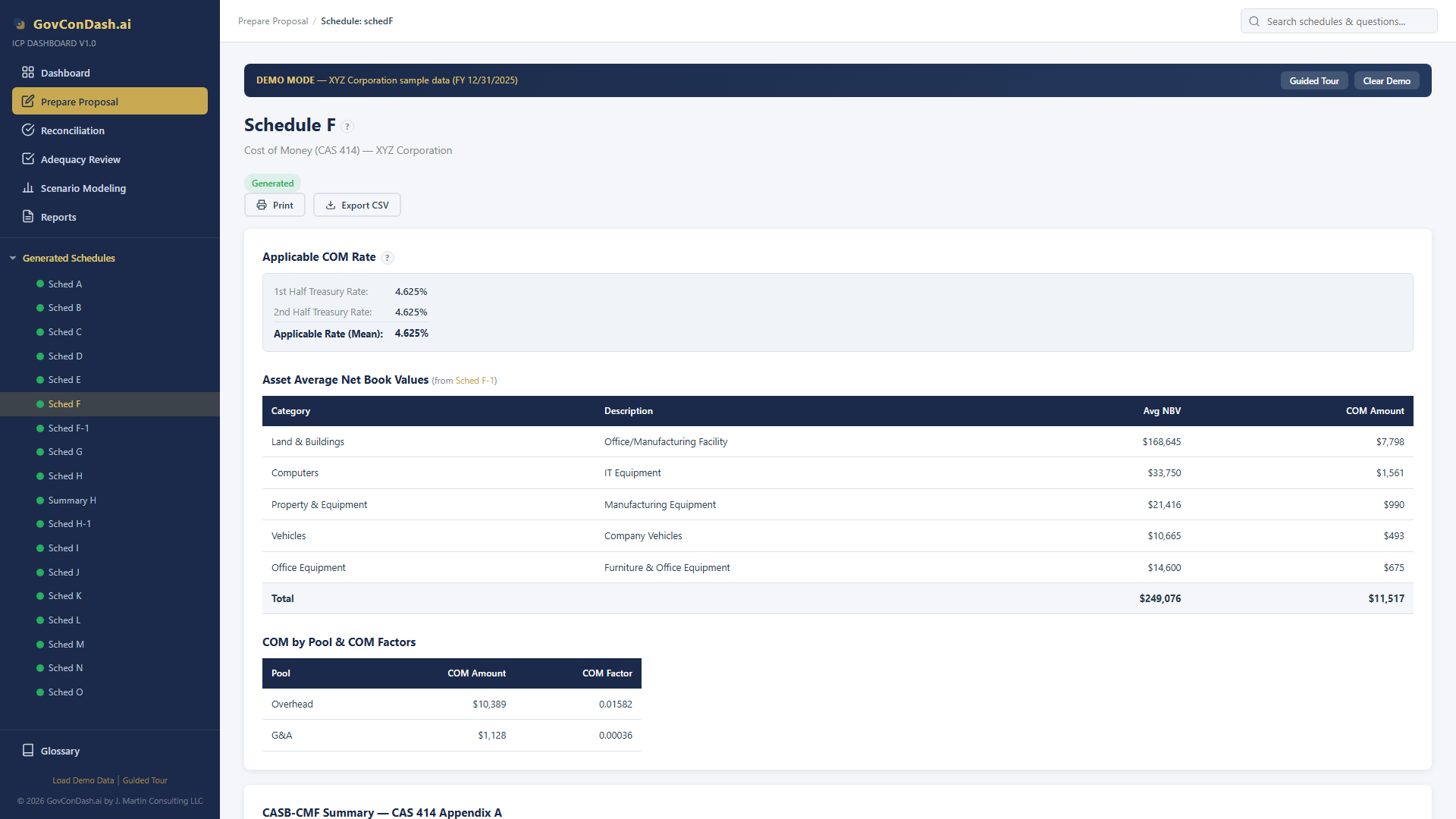
Schedule F summarizes the cost of money allocable to each pool. It shows the average NBV from Schedule F-1, the weighted Treasury rate for the fiscal year, the allocation to each pool, and the resulting cost-of-money rate that is applied alongside the indirect rate.

  • Pool — G&A, Overhead, Intermediate (one row each)
  • Avg. NBV — Net book value allocated to that pool (including a share of undistributed capital)
  • COM Rate — Arithmetic mean of the two semi-annual Treasury rates (per CAS 414-50(b))
  • FCCM $ — NBV × Rate, by pool
  • Base — The pool's allocation base in dollars
  • COM Factor — FCCM ÷ Base, carried to five decimal places
Generated Schedule F Cost of Money in the ICP Dashboard
Schedule F — Facilities Capital Cost of Money, generated automatically by the ICP Dashboard.

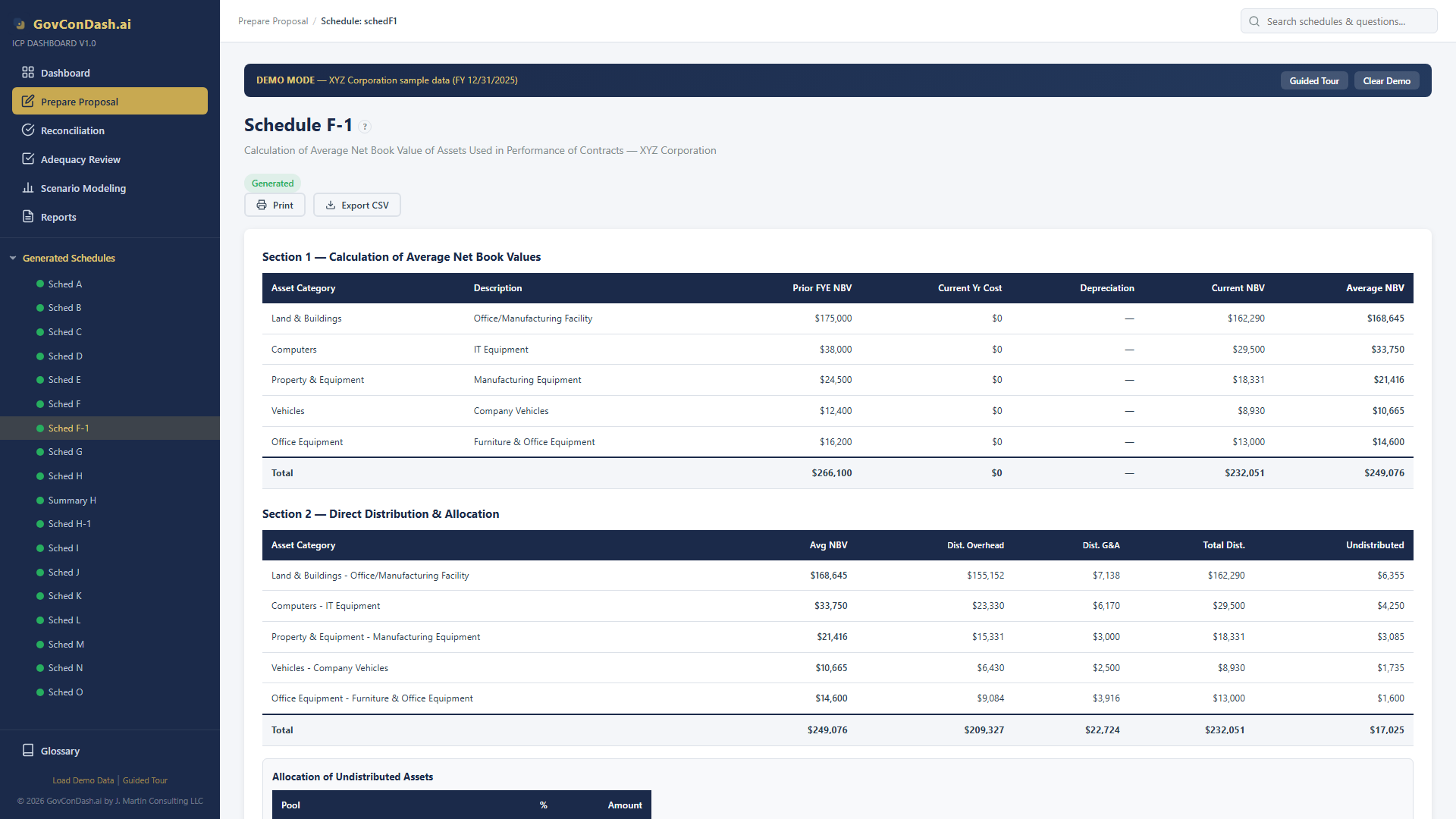
Schedule F-1 — Net Book Value Detail

Schedule F-1 supports Schedule F by listing each capital asset category and its average net book value over the fiscal year. NBV is computed as (Beginning NBV + Ending NBV) ÷ 2, by category, and assets must be those used in contract performance.

  • Land & Buildings — Land at cost; buildings net of depreciation
  • Leasehold Improvements — Net of amortization
  • Computer Equipment — Net of accumulated depreciation
  • Vehicles — Net of depreciation; exclude personal-use vehicles
  • Office Equipment — Furniture, fixtures, office machines
  • Other Capital — Production equipment, intangible capital per CAS 414 where applicable
Schedule F-1 Net Book Value detail
Schedule F-1 — supporting NBV detail by asset category.
DD Form 1861 Connection

The same NBV-times-Treasury-rate computation that produces Schedule F also drives DD Form 1861 — Contract Facilities Capital Cost of Money, which is required on most cost-reimbursement and price-redeterminable proposals. If your forward-pricing rate agreement (FPRA) includes COM rates, those rates must reconcile to the Schedule F rates you ultimately claim. See DCAA Guidebook Chapter 18 — Cost of Money for the auditor's procedures.

05 — Two Standards
CAS 414 vs. CAS 417
Two CAS standards address cost of money. Most contractors only need CAS 414 for facilities currently in productive use. CAS 417 covers a narrower case — capital assets still under construction — where the cost is capitalized into the asset rather than expensed.
CAS 414

Facilities Capital Cost of Money

Assets in productive use

Applies to capital assets currently used in contract performance. The cost-of-money charge is computed annually and treated as an allowable cost on the contracts the facilities serve.

  • Trigger — Asset is in service, depreciating, used for contracts
  • Treatment — Allowable cost; reported on Schedule F
  • Form — DD Form 1861 (for pricing actions)
  • AllowabilityFAR 31.205-10
  • Frequency — Computed each fiscal year
CAS 417

Cost of Money — Construction

Capital assets under construction

Applies to capital assets that are being constructed, fabricated, or developed for the contractor's own use. The cost of money accrued during the construction period is capitalized into the asset.

  • Trigger — Asset is under construction (not yet in service)
  • Treatment — Capitalized into the cost basis of the asset
  • Recovery — Through depreciation once the asset is placed in service
  • AllowabilityFAR 31.205-10
  • Frequency — Accrued during the construction period only
Practical Note

For most small and mid-size government contractors, only CAS 414 applies — you simply compute COM on the assets sitting in your fixed-asset register. CAS 417 only comes into play if you are building a capital asset for your own use (a manufacturing facility, custom test equipment, capitalized internal software). Both standards point to the same Treasury rate; what differs is whether the COM is expensed (414) or capitalized (417).

06 — Three Steps to Claim
From Fixed-Asset Register to Schedule F
Claiming cost of money is a three-step workflow: identify the assets, capture the rate, allocate by pool. The ICP Dashboard automates the math — you supply the inputs and it produces Schedule F and F-1 with the correct allocations and Treasury weighting.

1. NBV Inputs

Enter beginning + ending NBV by asset category

2. Allocation

Tag each asset group to G&A, OH, or Intermediate

3. Treasury Rate

Enter rate(s) for the fiscal year — weighted if a change occurs

4. Schedule F Output

Generate F & F-1 with COM rates by pool

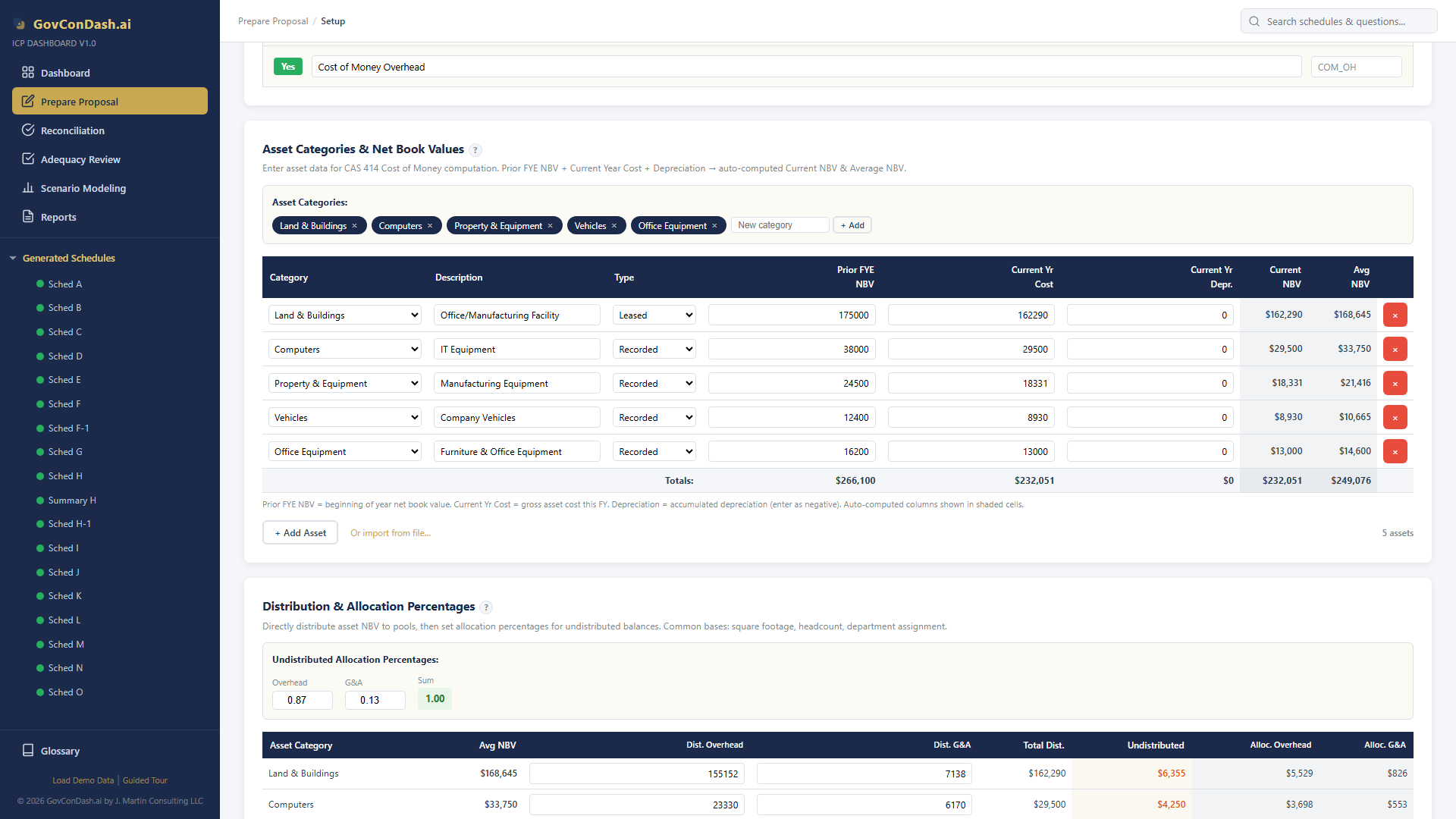
Step 1 — Capture Asset NBV

Enter average net book value for each capital asset group. The dashboard computes (Beginning + Ending) ÷ 2 for each row and totals by category. This becomes the input to Schedule F-1.

  • Land & Buildings — Land at cost, buildings net of depreciation
  • Leasehold Improvements — Net of amortization
  • Computer Equipment — Net of depreciation
  • Vehicles — Net of depreciation (exclude personal-use)
  • Office Equipment & Other — Furniture, fixtures, production equipment
Cost of Money asset entry in the ICP Dashboard wizard
Step 1 of the wizard — capital asset NBV entry by category.

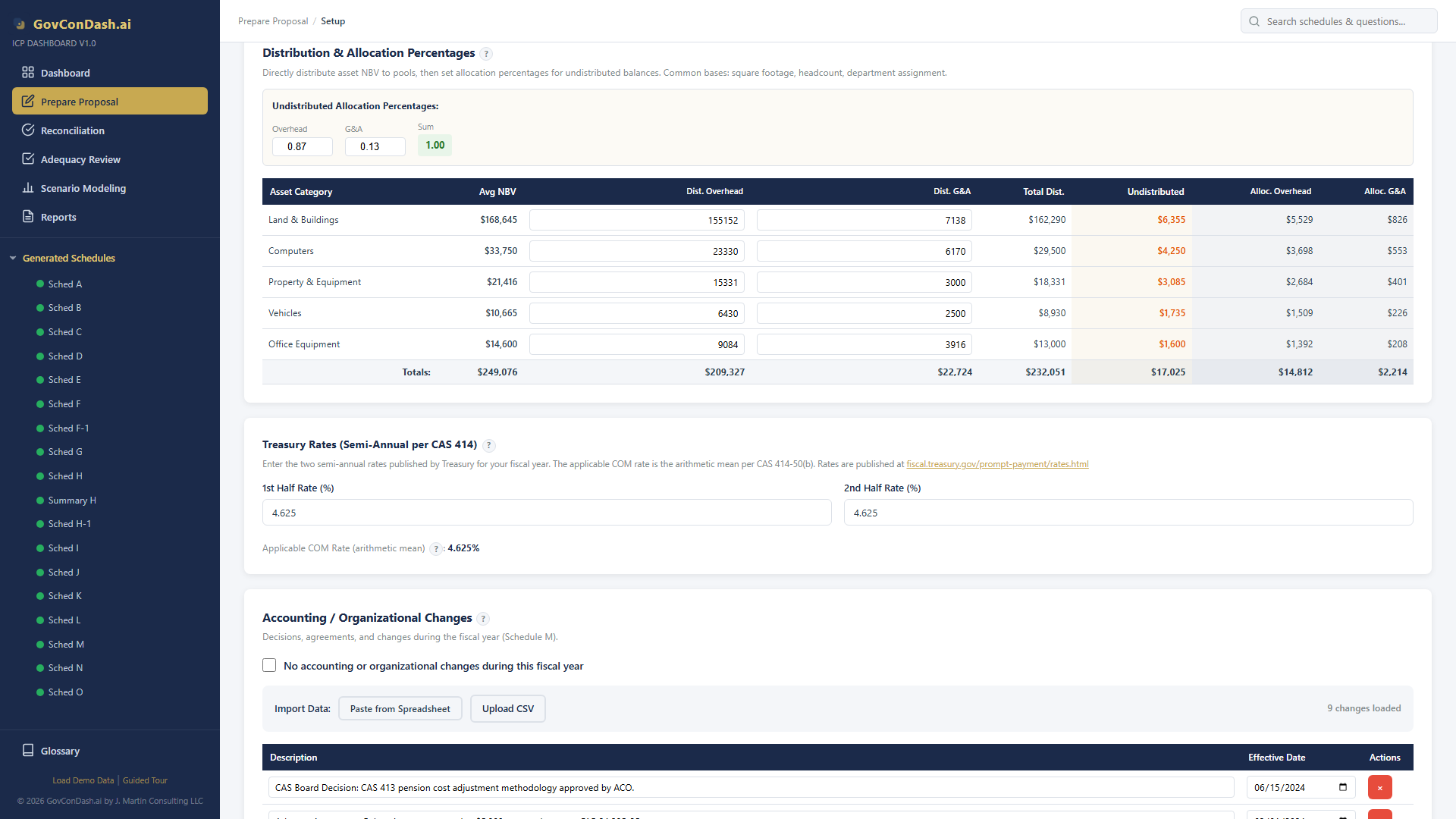
Step 2 — Allocate to Pools

Tag each asset group to the indirect pool that benefits from it. Manufacturing equipment typically allocates to Overhead. Corporate buildings, executive vehicles, and shared IT assets typically allocate to G&A. Intermediate pools (e.g., Occupancy) get the assets they consume.

  • Overhead — Production equipment, plant facilities
  • G&A — Corporate buildings, exec vehicles, ERP systems
  • Intermediate — Shared occupancy, IT pool assets
  • Excluded — Personal-use, non-contract, idle facilities
COM allocation step in the wizard
Step 2 — allocate each asset group to the appropriate pool.

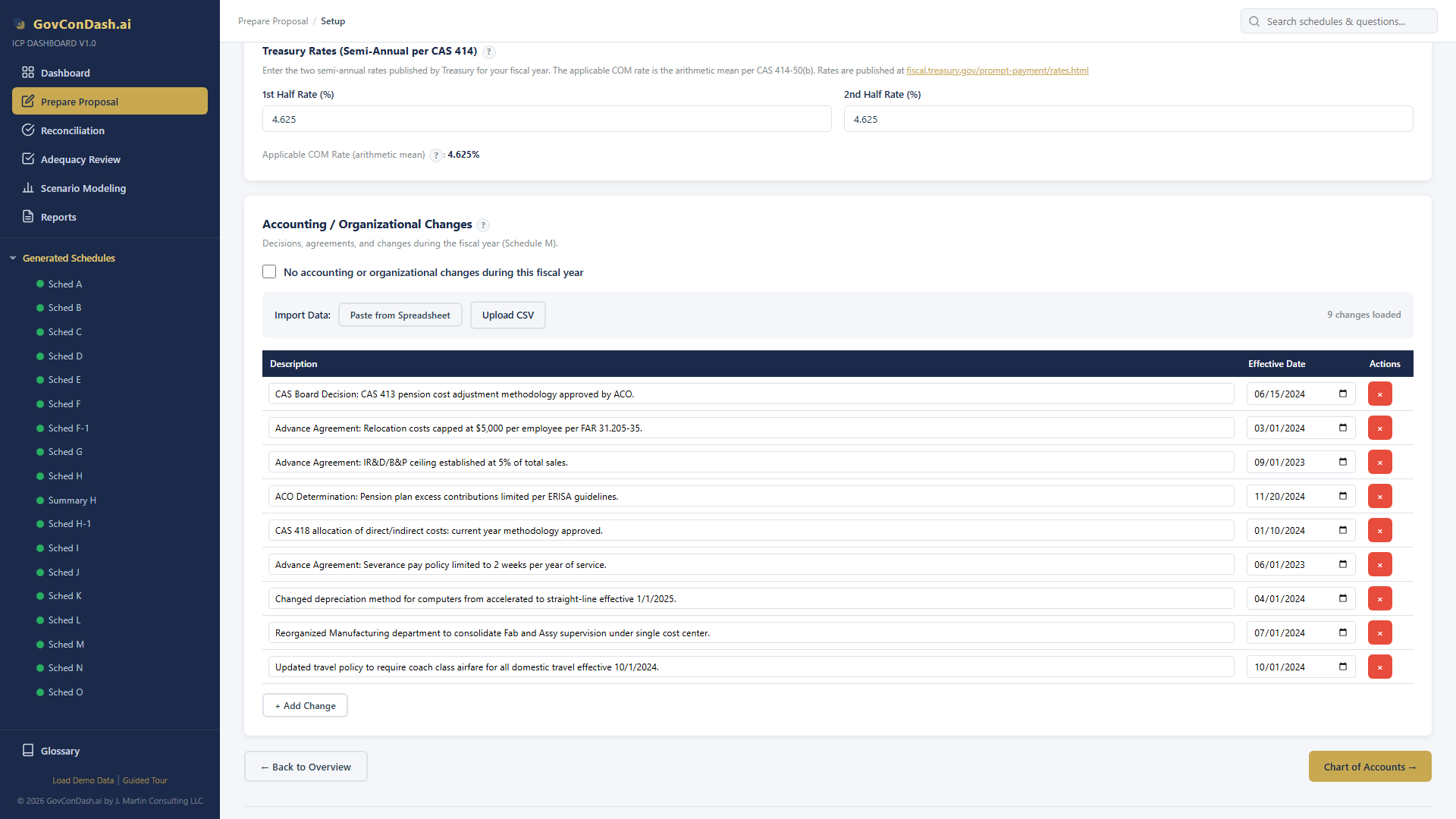
Step 3 — COM Rate

Enter both semi-annual Treasury rates in effect during the fiscal year. Per CAS 9904.414-50(b), the applicable COM rate is the arithmetic mean of the two — the dashboard computes it automatically and applies it to each pool's average NBV.

Treasury rate entry for cost of money
Step 3 — enter the Treasury rate(s); weighting is automatic.
07 — Common Mistakes
Cost of Money Pitfalls
These are the recurring errors DCAA flags during incurred cost audits of Schedule F. Most are mechanical — wrong NBV, wrong rate, wrong allocation — but a few stem from misunderstanding what cost of money is and is not.

Forgetting to Claim It

The most common error: omitting Schedule F entirely. Cost of money is allowable but not automatic — if you do not claim it, the government will not pay it. Money on the table.

Using a Single-Period Rate

Treasury rates change every six months. CAS 414-50(b) requires the arithmetic mean of the two semi-annual rates — using only one half-year's rate produces an incorrect FCCM and is an easy DCAA finding.

Including Personal or Idle Assets

Vehicles for personal use, vacation property, or facilities not used in contract performance must be excluded from NBV. Including them inflates COM and creates questioned costs.

Using Beginning or Ending NBV Only

The standard requires average NBV — (Beginning + Ending) ÷ 2 by category. Snapshotting one point in time inflates or deflates the base improperly.

Mis-Allocating Across Pools

Tagging factory equipment to G&A (or vice versa) distorts each pool's COM rate. Allocate based on which pool's activities the asset actually supports — consistent with the indirect pool structure.

Double-Counting Interest

Interest expense is unallowable under FAR 31.205-20. Cost of money is the only permitted form of cost-of-capital recovery. Some contractors mistakenly attempt to claim both — a guaranteed disallowance.

Schedule F Not Reconciling to F-1

Schedule F's NBV totals must tie exactly to Schedule F-1 detail by asset category. Footing errors or transposed figures here trigger an immediate adequacy comment.

Schedule F Not Tied to FPRA

If you have a forward-pricing rate agreement that includes COM, the Schedule F result must reconcile to the FPRA basis. Unexplained variances invite DCAA to renegotiate forward rates downward.

Applying COM to IR&D / B&P

IR&D and B&P rows receive fringe and overhead only — never G&A or COM. Forgetting to deduct COM on the IR&D/B&P portion of the G&A base causes double-counting and is one of the most frequent DCAA questioned costs on Schedule F.

Rounding COM Factors Too Early

COM factors must be carried to five decimal places (not four, like indirect rates). Rounding early distorts contract-level COM recovery and produces reconciliation breaks between Schedule F and Schedule H.

Bottom Line

Cost of money is one of the few allowable costs in the FAR/CAS framework that returns dollars to the contractor with zero cash outlay. The math is simple, the documentation is bounded by the fixed-asset register, and the rate is published by the government — yet contractors leave it on the table every year by skipping Schedule F or computing it wrong. Done correctly under CAS 414, FCCM is one of the highest-margin compliance activities a government contractor can perform.

Generate Schedule F in Minutes

The ICP Dashboard automates the full cost-of-money computation — NBV averaging, CAS 414-50(b) rate mean, undistributed-capital allocation, IR&D/B&P deduction, and Schedule F / F-1 generation — from your fixed-asset register straight into your incurred cost submission.

IncurredCostProposal.com