DCAA Adequacy Checklist
All 47 Questions Explained

The complete guide to every question on the DCAA Adequacy Checklist (v3.4) — what each one means, why it matters, and how the ICP Dashboard verifies it for you.
47
Questions
15
Schedules Covered
v3.4
Checklist Version
100%
Auto-Verified
01 — Overview
What Is the Adequacy Checklist?
Before DCAA will even consider auditing your Incurred Cost Proposal, it must first pass a formal adequacy screening. The checklist is your gateway to the audit process.

47 Mandatory Questions

Each question maps to a specific ICE Model schedule (A through O) and checks whether required data was submitted, is complete, and ties correctly to other schedules.

FAR 52.216-7 Requirement

The adequacy review is mandated by FAR 52.216-7 and DCAA CAM 6-707.1. An inadequate proposal is returned to the contractor, delaying rate settlement and cash flow.

Two Assessments Per Question

Received (Y/N/NA) — was the required information submitted? Adequate (Y/N) — is the information complete and internally consistent?

Pass/Fail Determination

All 47 items must receive “Y” for Received and “Y” for Adequate to pass. A single “N” on any question makes the entire proposal inadequate.

Completeness, Not Allowability

The adequacy review checks that your ICP is complete and internally consistent. It does not determine whether your costs are allowable — that comes during the actual audit.

Cash Flow Impact

An inadequate ICP triggers decrement factors on provisional billing rates. DCAA recommends rate reductions to the CO when proposals are six months delinquent, directly hurting cash flow.

02 — The 60-Day Rule
DCAA Has 60 Days to Evaluate Your Proposal
The 2018 NDAA requires DCAA to evaluate and respond to every incurred cost proposal within 60 days of receipt. Understanding this timeline is critical to protecting your cash flow.
Day 0
1
Fiscal Year End
Contractor’s fiscal year closes; the clock starts on the 6-month submission deadline
6 months
Month 6
2
ICP Due
Incurred cost proposal with Schedules A–O submitted to DCAA within 6 months per FAR 52.216-7
60 days
Month 8
3
Adequacy Determination
Auditor evaluates using the Adequacy Checklist and notifies contractor in writing per the 2018 NDAA
03 — Dashboard Integration
Built Into the ICP Dashboard
The dashboard embeds all 47 questions with interactive tracking, auto-population from your generated schedules, and exportable reports.

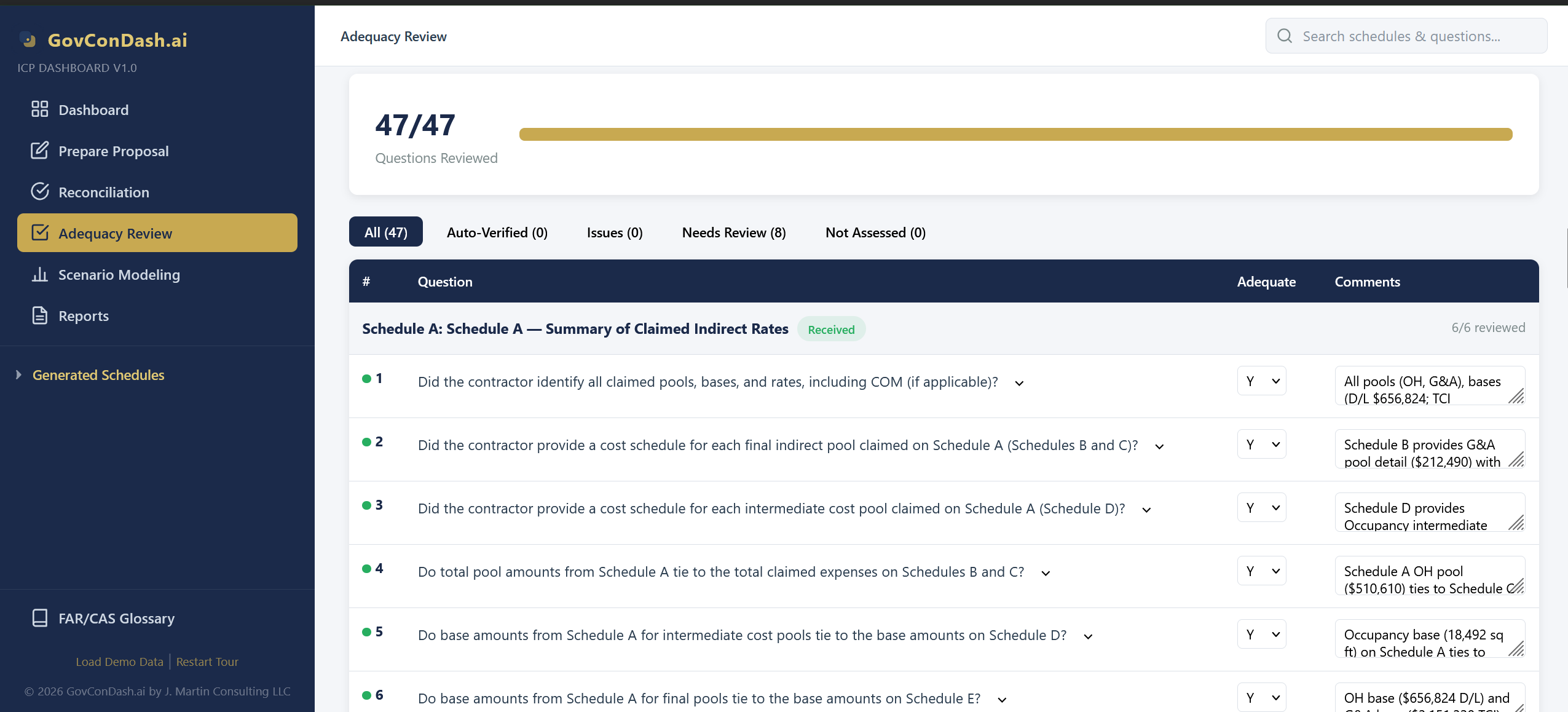
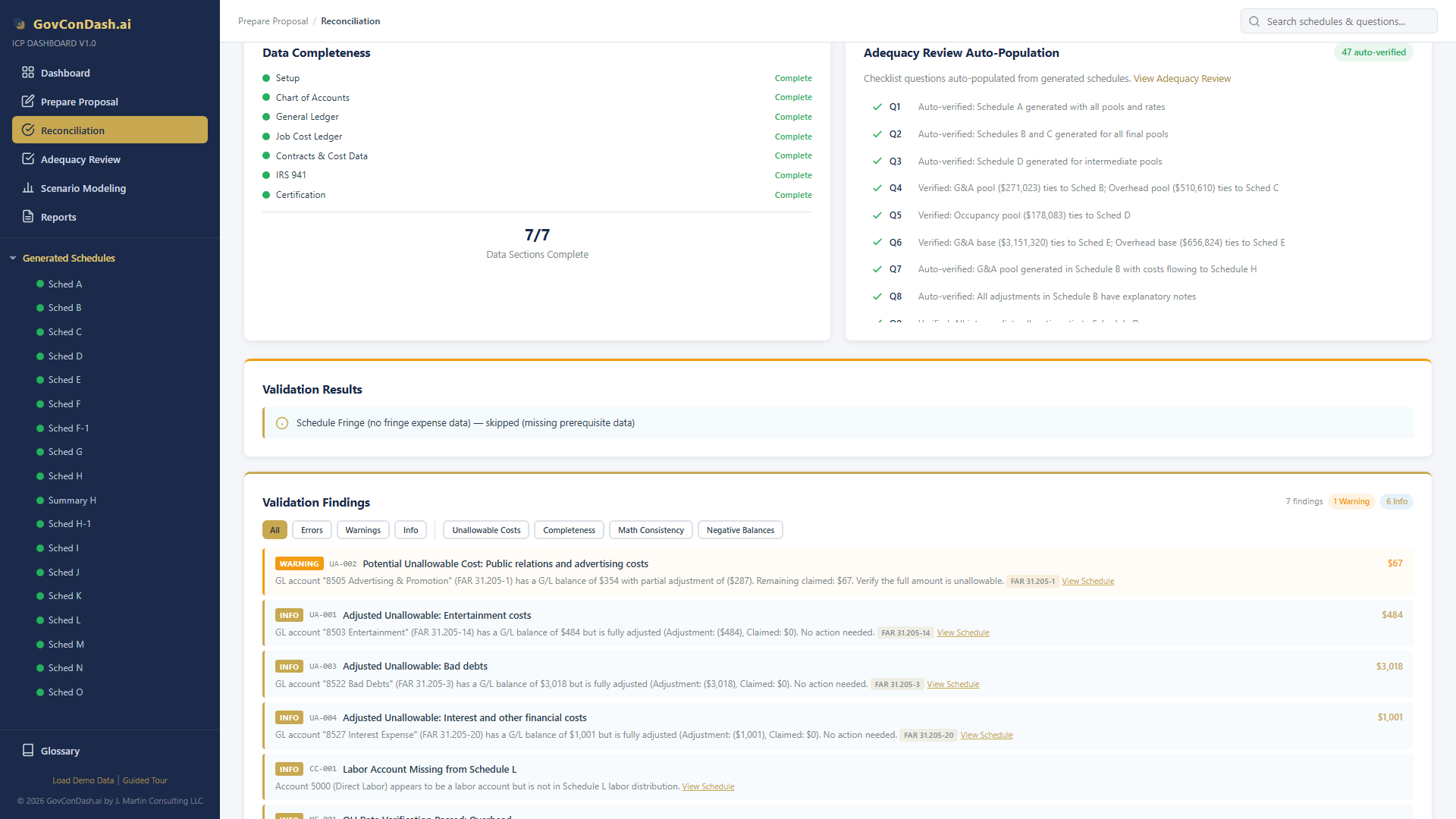
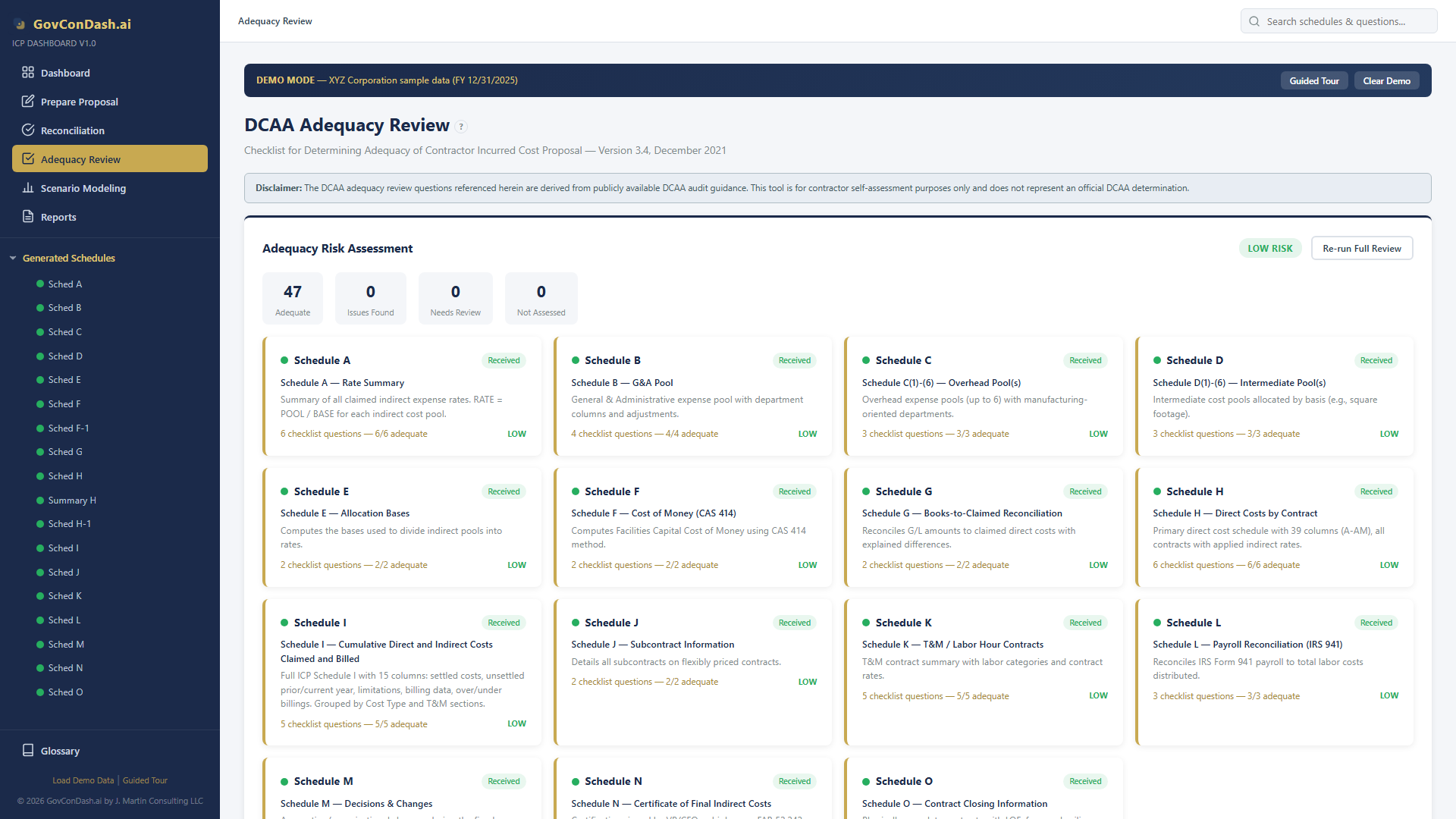
Adequacy Review Overview

See your progress at a glance: how many questions are assessed, how many pass, and which schedule groups need attention. The progress bar updates in real time as you work through each question.

  • Progress tracking — visual bar shows assessed vs. remaining
  • Schedule groups — questions organized by ICE schedule (A through O)
  • Risk scoring — flags high-risk items that commonly trigger DCAA rejection
Adequacy Review Overview
The Adequacy Review page with schedule group cards and progress tracking

Individual Question Assessment

Each of the 47 questions has its own detail card. Mark Received (Y/N/NA) and Adequate (Y/N), add comments, and link supporting evidence. The dashboard pre-fills assessments from your generated schedules.

  • Auto-population — reconciliation checks feed into checklist answers
  • Comments — document your rationale for each assessment
  • Export — generate an Excel adequacy report with all 47 responses
Adequacy Review with all 47 questions assessed
The Adequacy Review table showing all 47 questions with Adequate assessments and comments
04 — Schedule A
Rate Summary: Questions 1–6
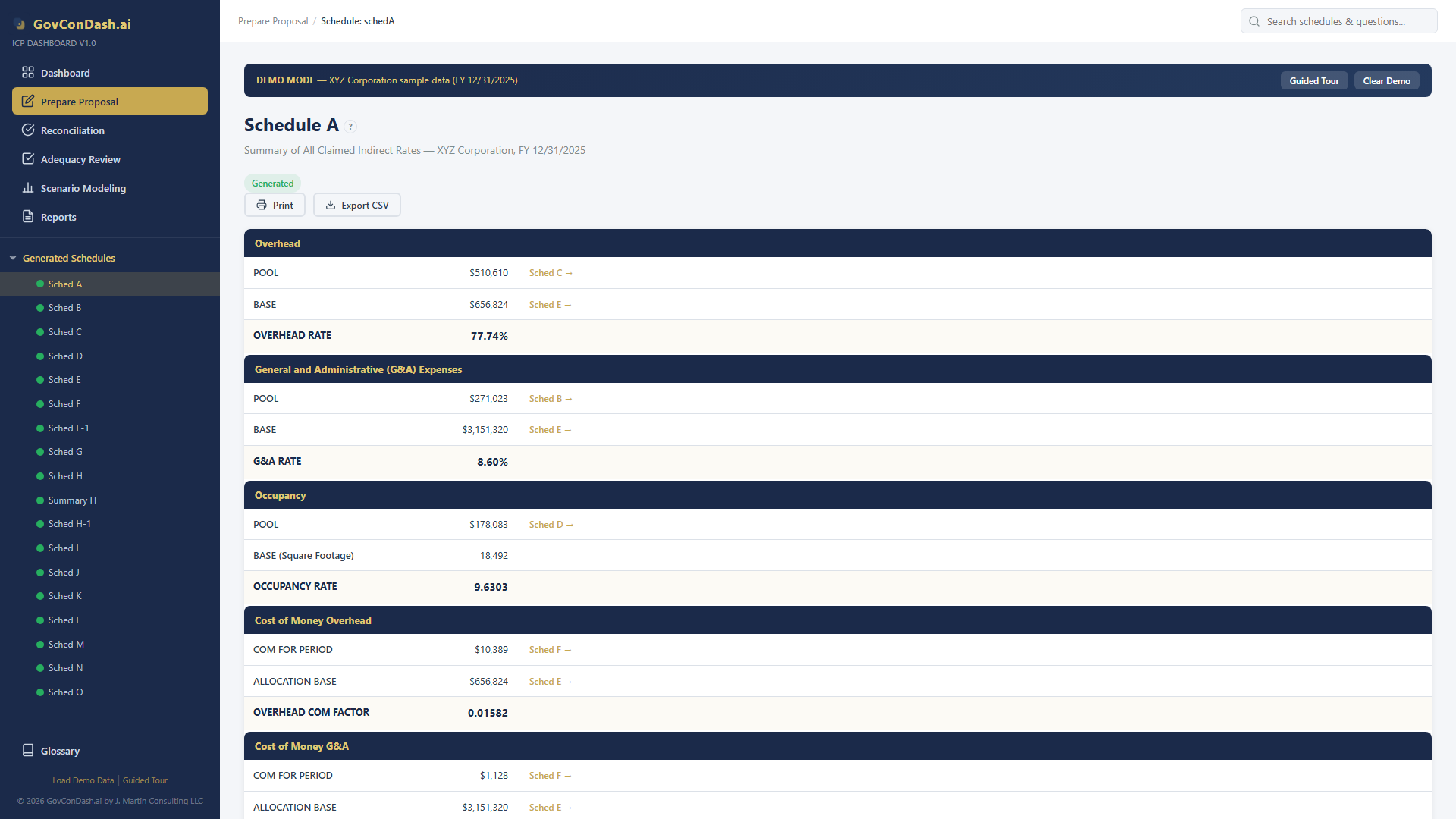
Schedule A is the master summary of all claimed indirect rates. These six questions verify that every pool, base, and rate is identified, supported, and internally consistent.
1
Did the contractor identify all claimed pools, bases, and rates, including COM (if applicable)?
Tip: Ensure every final and intermediate pool appears on Schedule A with its base and computed rate. If claiming Cost of Money, COM factors must appear as separate line items.
2
Did the contractor provide a cost schedule for each final indirect pool claimed on Schedule A (Schedules B and C)?
Tip: Each final pool on Schedule A needs a supporting detail schedule — Schedule B for G&A, Schedule C for each overhead pool.
3
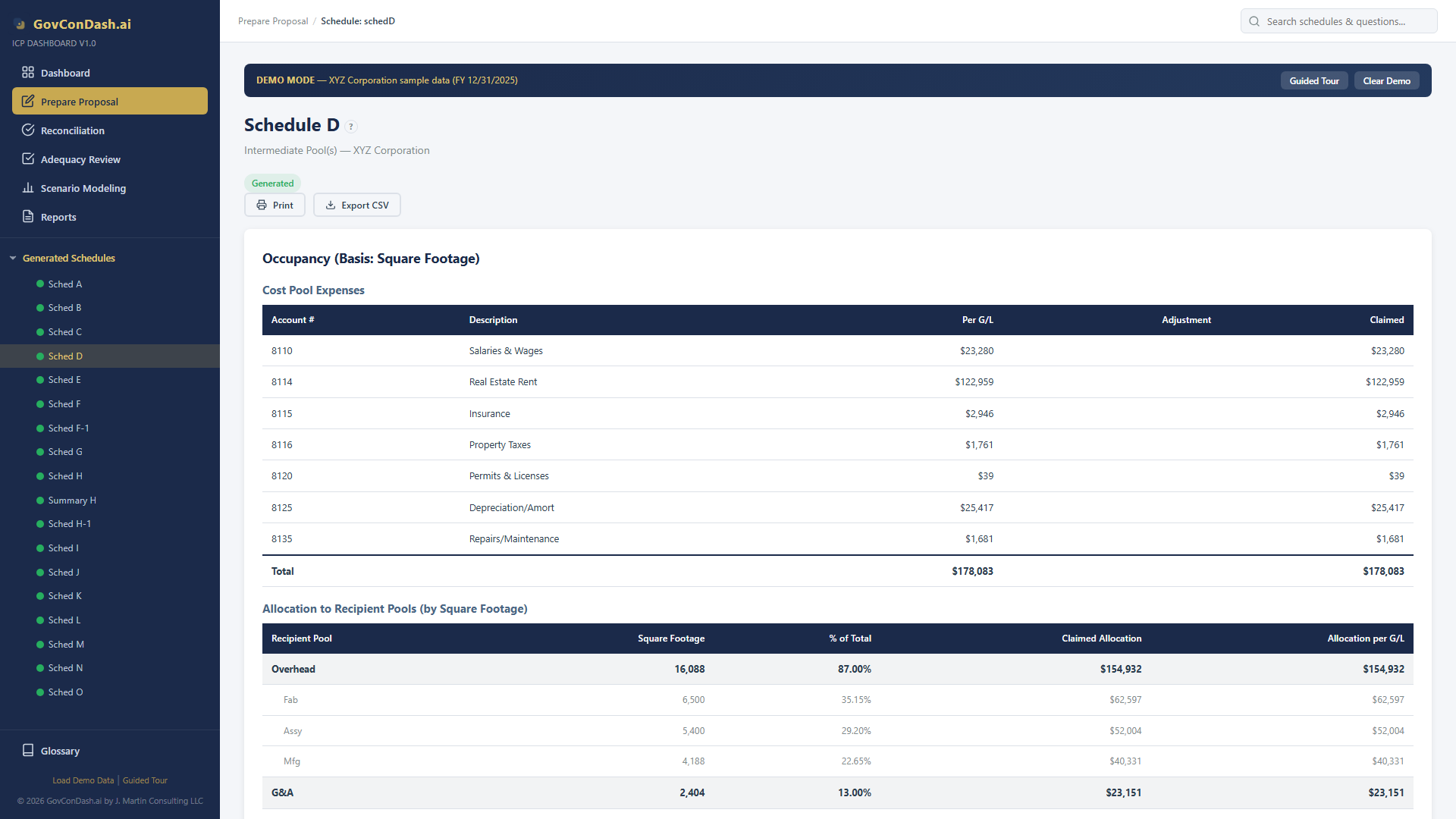
Did the contractor provide a cost schedule for each intermediate cost pool claimed on Schedule A (Schedule D)?
Tip: If you have occupancy, facilities, or other intermediate pools, each must have a Schedule D showing allocation to final pools.
4
Do total pool amounts from Schedule A tie to the total claimed expenses on Schedules B and C?
Tip: The pool amounts shown on Schedule A must exactly equal the grand totals from the corresponding B and C schedules. A $1 difference will trigger a finding.
5
Do base amounts from Schedule A for intermediate cost pools tie to the base amounts on Schedule D?
Tip: Intermediate pool bases (e.g., square footage, headcount) must match between Schedule A and their Schedule D detail.
6
Do base amounts from Schedule A for final pools tie to the base amounts on Schedule E?
Tip: OH and G&A base amounts on Schedule A must match Schedule E. This is one of the most common adequacy failures — verify your base calculations are consistent.
Schedule A — Rate Summary
05 — Schedules B, C & D
Indirect Cost Pool Detail: Questions 7–16
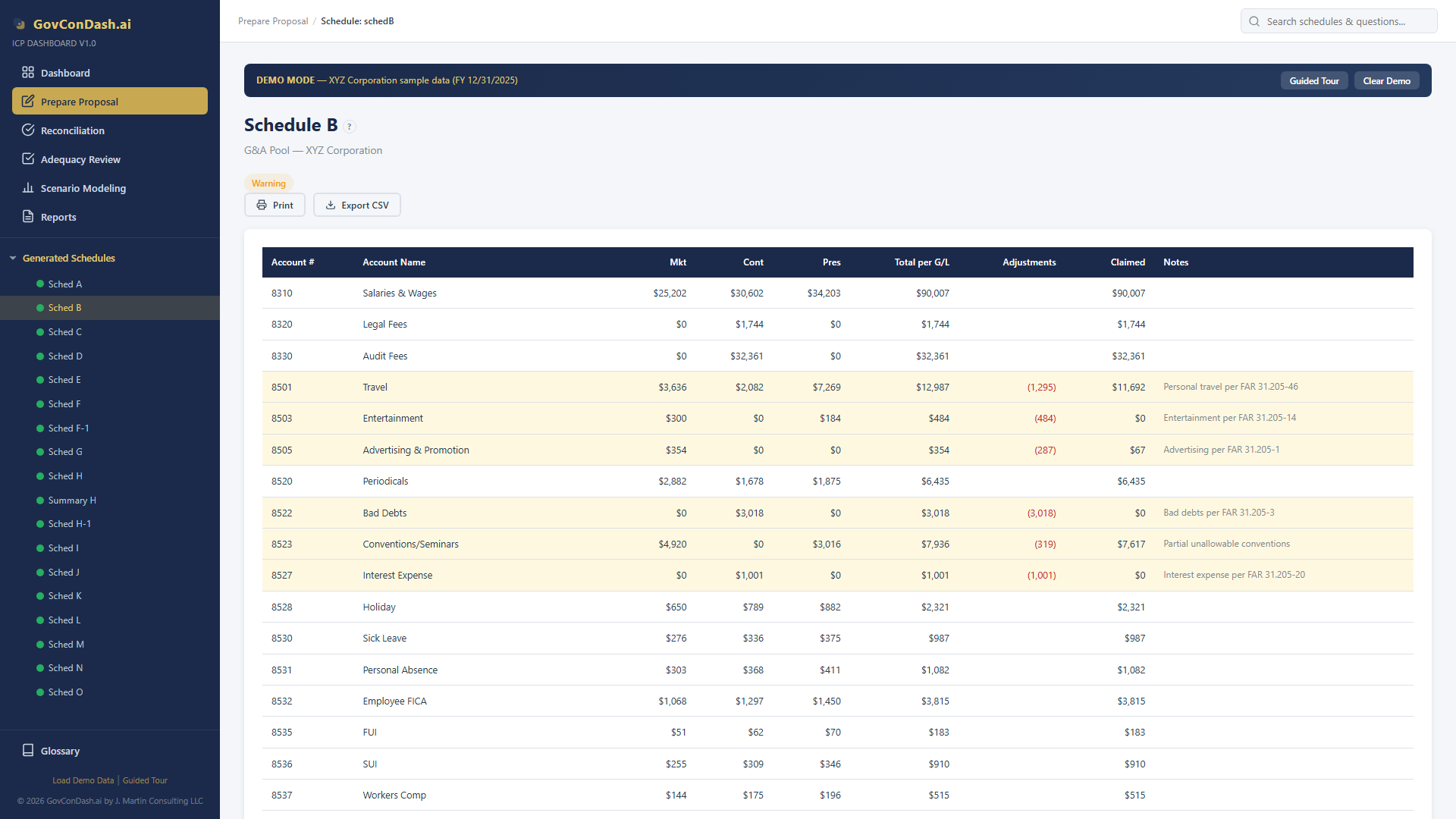
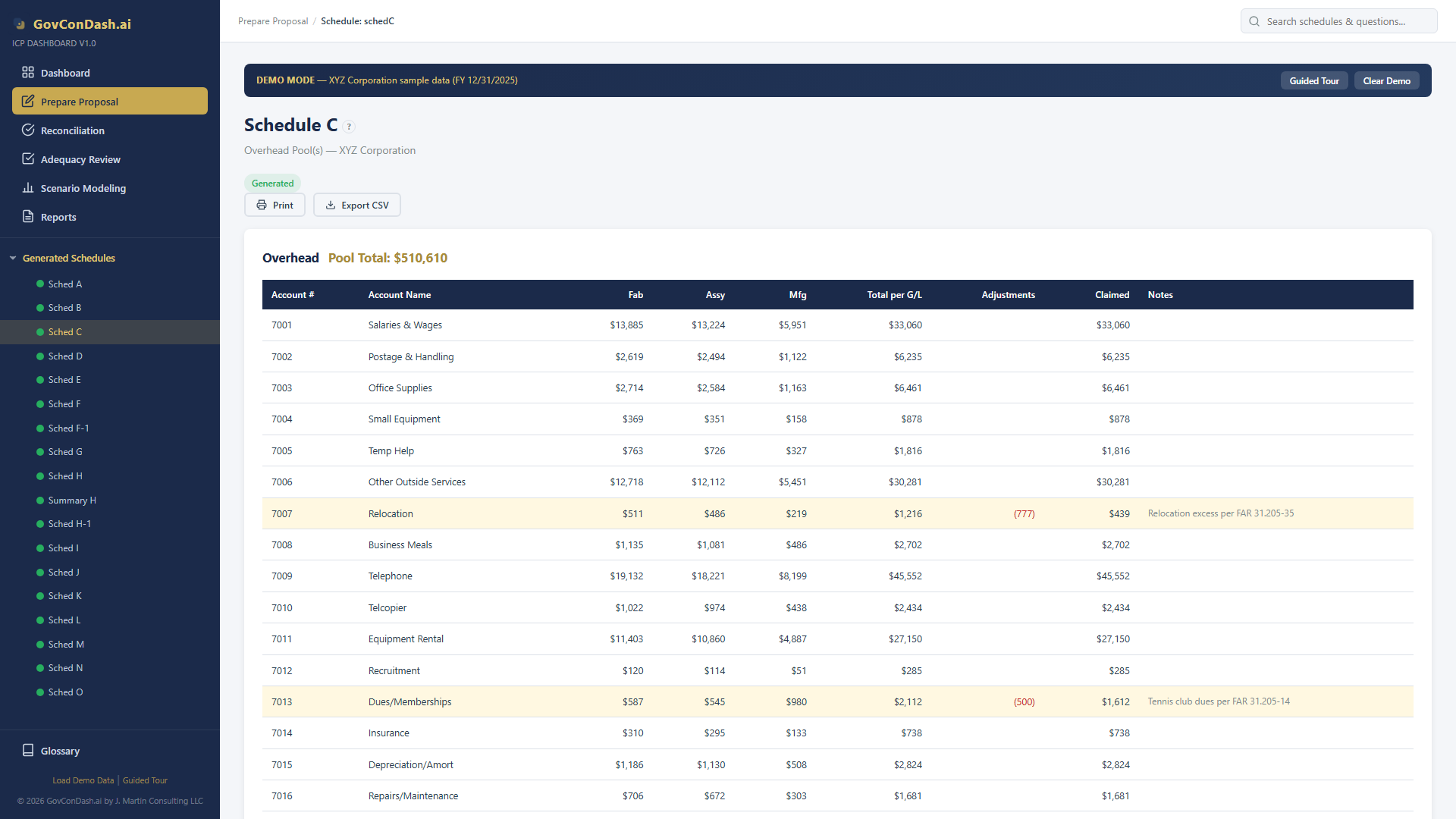
These ten questions verify that every indirect cost pool — G&A (B), Overhead (C), and Intermediate (D) — is properly documented, with adjustments explained and intermediate allocations traceable.
SCHED B
G&A Expenses
7
Do total G&A pool costs tie to Schedule H?
The G&A pool total on Schedule B must equal the G&A amount applied on Schedule H. Include IR&D/B&P applied costs.
8
Did the contractor include explanatory notes for any amounts in an adjustment column or amounts omitted from the claim?
Every adjustment (e.g., unallowable cost removal) needs a note explaining what was adjusted and why.
9
Do the intermediate allocations appear on source schedules (e.g., Schedule B intermediate allocation amounts to Schedule D allocations)?
If occupancy or other intermediate costs are allocated to G&A, the amounts must trace back to Schedule D.
10
Was the applicable fringe and overheads applied to the IR&D/B&P?
IR&D/B&P costs flowing into the G&A pool must include applied fringe and OH. This is a frequent adequacy failure.
SCHED C
Overhead Expenses
11
Do total OH pool costs for each pool tie to Schedule H?
Each OH pool total on Schedule C must equal the corresponding amount on Schedule H.
12
Did the contractor include explanatory notes for any amounts in an adjustment column or amounts omitted from the claim?
Same as Q8 but for overhead pools. Document every unallowable cost removal or reclassification.
13
Do the intermediate allocations appear on source schedules (e.g., Schedule C intermediate allocation amounts to Schedule D allocations)?
Intermediate cost allocations flowing into OH pools must trace to Schedule D detail.
SCHED D
Intermediate Pools
14
Did the contractor include explanatory notes for any amounts in an adjustment column or amounts omitted from the claim?
Intermediate pool adjustments need the same level of documentation as final pools.
15
Do the intermediate allocations appear on source schedules?
Amounts allocated from D to B and C must match what those schedules show as received from intermediates.
16
Does the schedule identify (1) allocation base by recipient, (2) percentage of total base for each recipient, and (3) dollars allocated to each recipient?
Schedule D must show the allocation mechanics: base units, percentages, and dollar amounts for each receiving pool.
Schedule B — G&A Pool
Schedule C — Overhead Pool
Schedule D — Intermediate Pool
06 — Schedules E, F, G & H
Bases, COM & Contracts: Questions 17–28
The heart of the ICP: allocation bases (E), Cost of Money (F), reconciliation (G), and the master contract schedule (H). These twelve questions cover the most audit-sensitive areas.
SCHED E
Allocation Bases
17
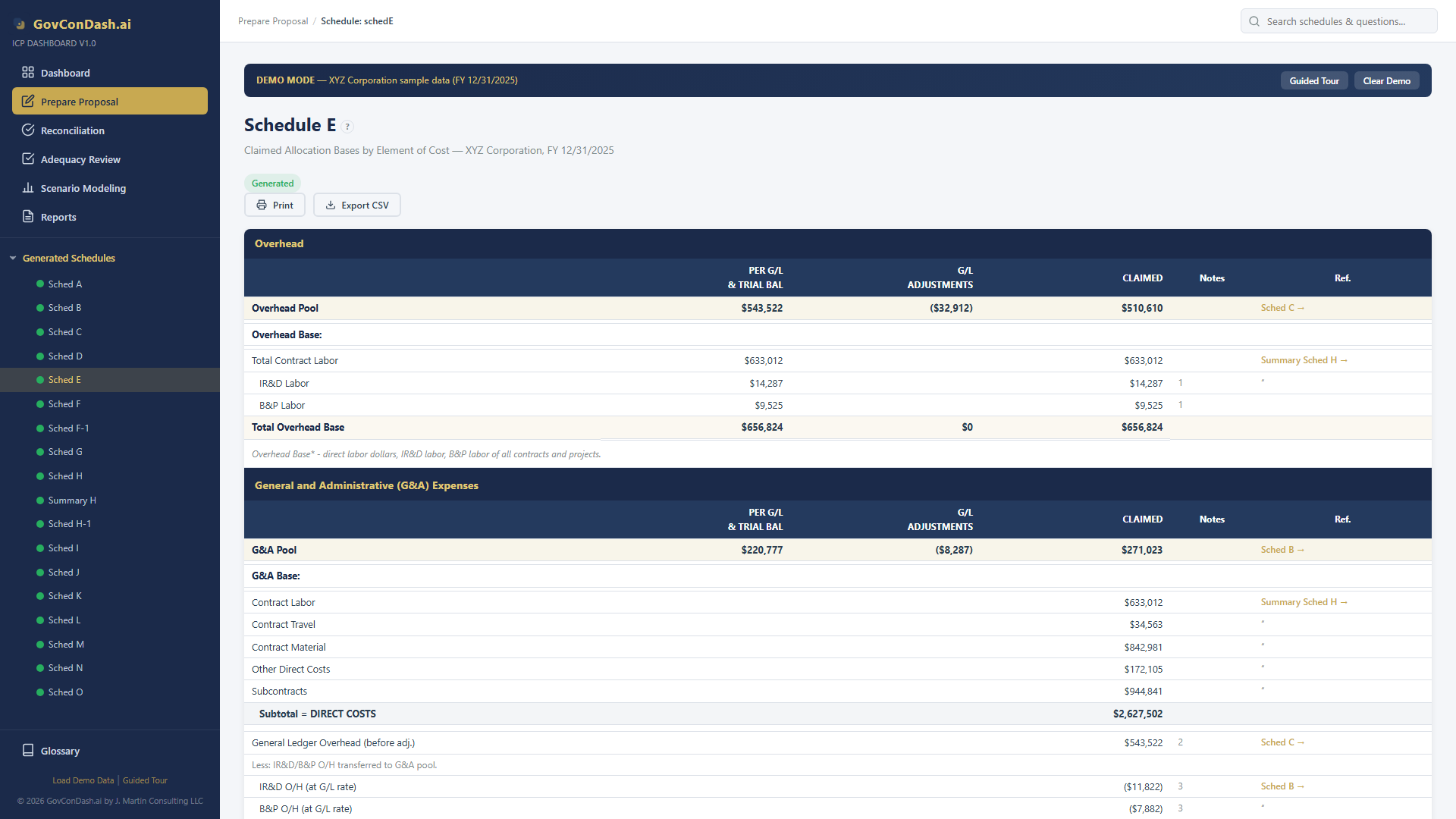
Does the schedule include an explanation of each base?
Clearly describe what makes up each allocation base (e.g., Direct Labor, TCI, Value Added) and why it was selected.
18
Do base amounts show individual cost elements that tie with costs on referenced schedules and include explanatory notes?
Each cost element in the base must trace to Schedules H, B, or C. This cross-schedule tie-out is critical.
SCHED F
Cost of Money
19
Do the allocation bases used match corresponding allocation bases claimed in Schedule A?
COM factors must use the same bases as the indirect rates on Schedule A — no mixing bases.
20
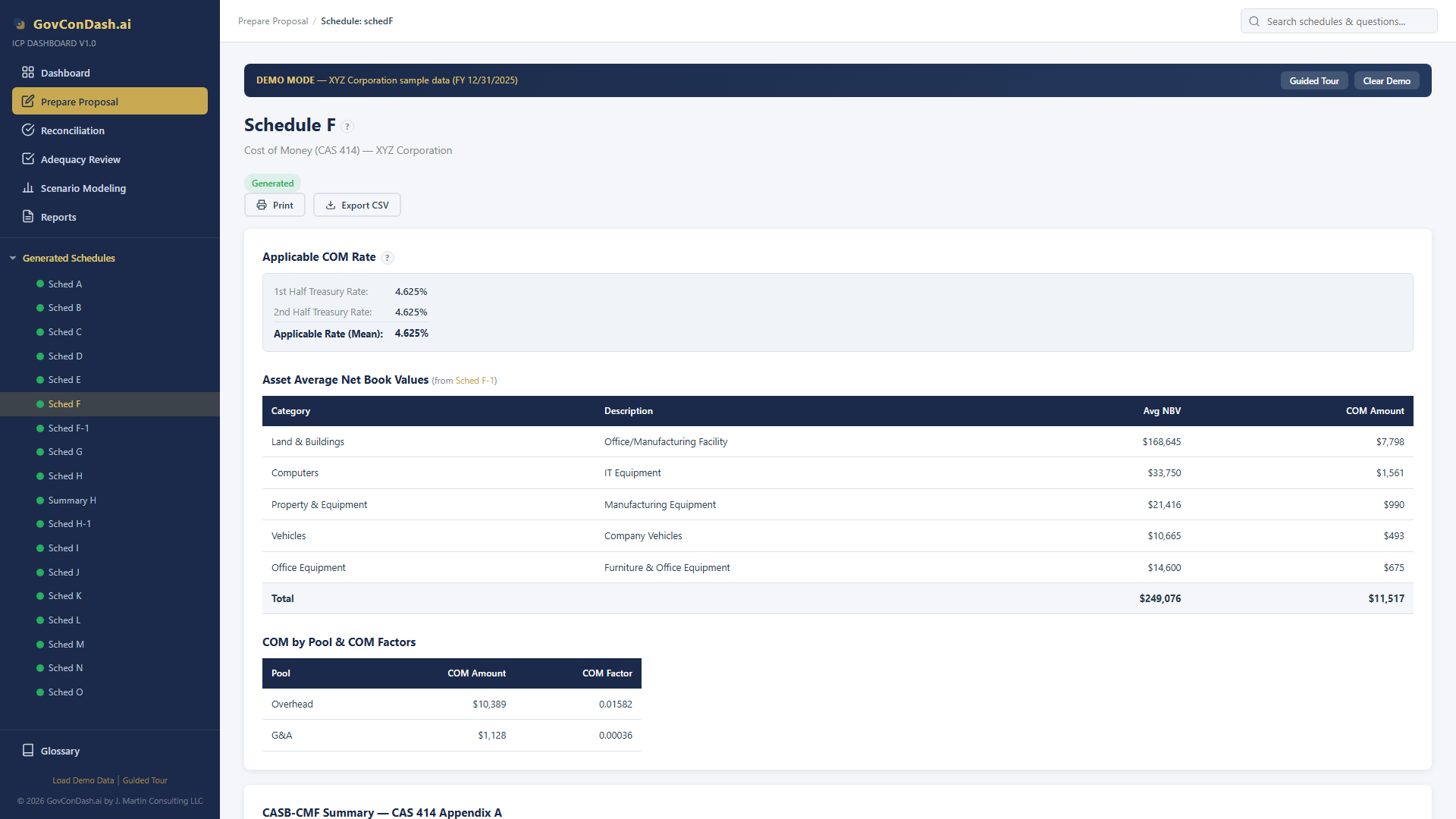
Did the contractor calculate a separate COM rate (if applicable) for each final indirect pool?
Each pool claiming COM needs its own factor calculated from net book values and Treasury rates per CAS 414.
SCHED G
Reconciliation
21
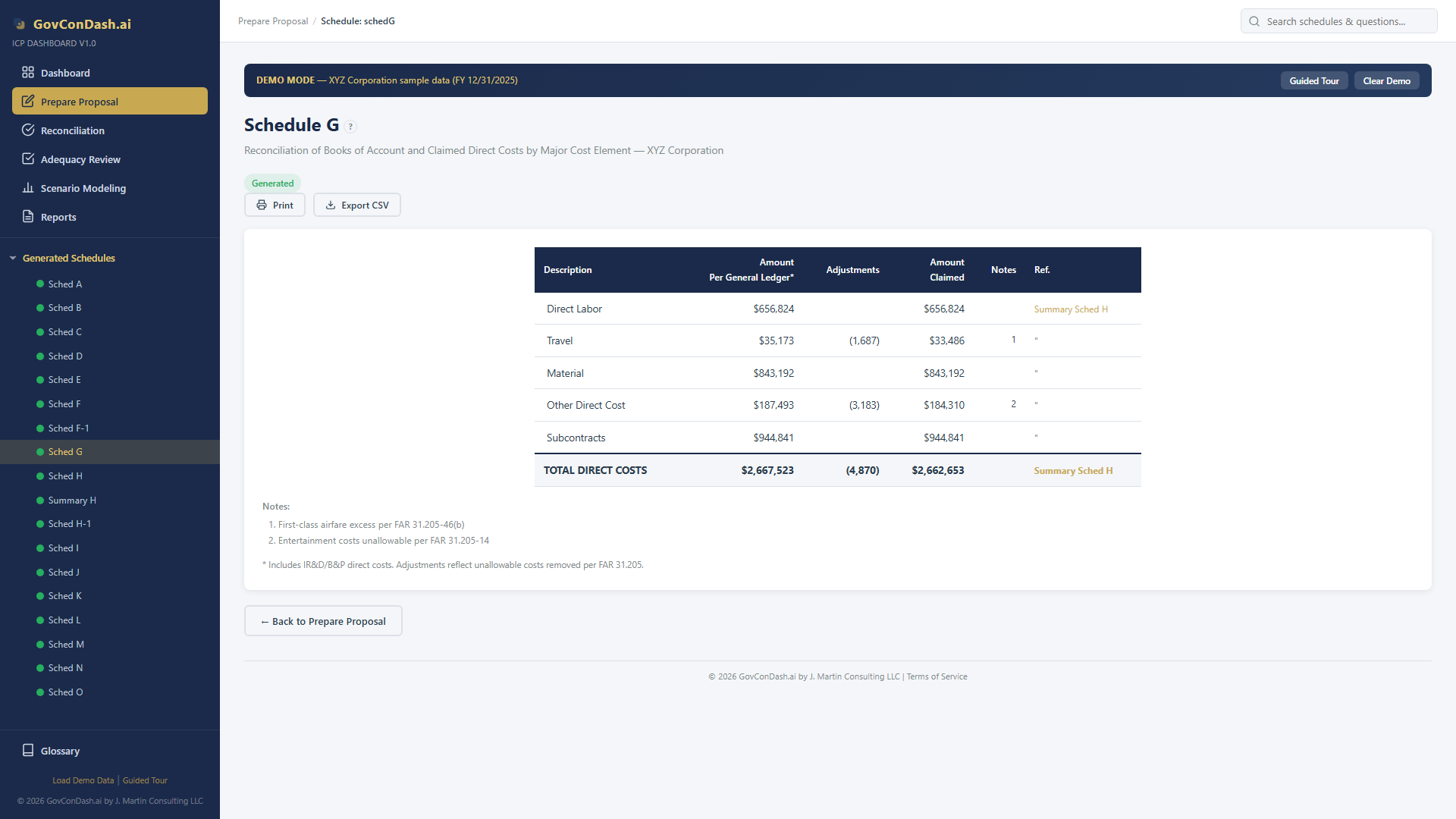
Do the direct cost amount per general ledger column tie to Schedule H?
Total direct costs from your books must reconcile to what appears on Schedule H. Any difference must be explained.
22
Did the contractor include explanatory notes for any amounts in an adjustment column or amounts omitted from the claim?
Reconciliation adjustments need the same documentation rigor as pool adjustments.
SCHED H
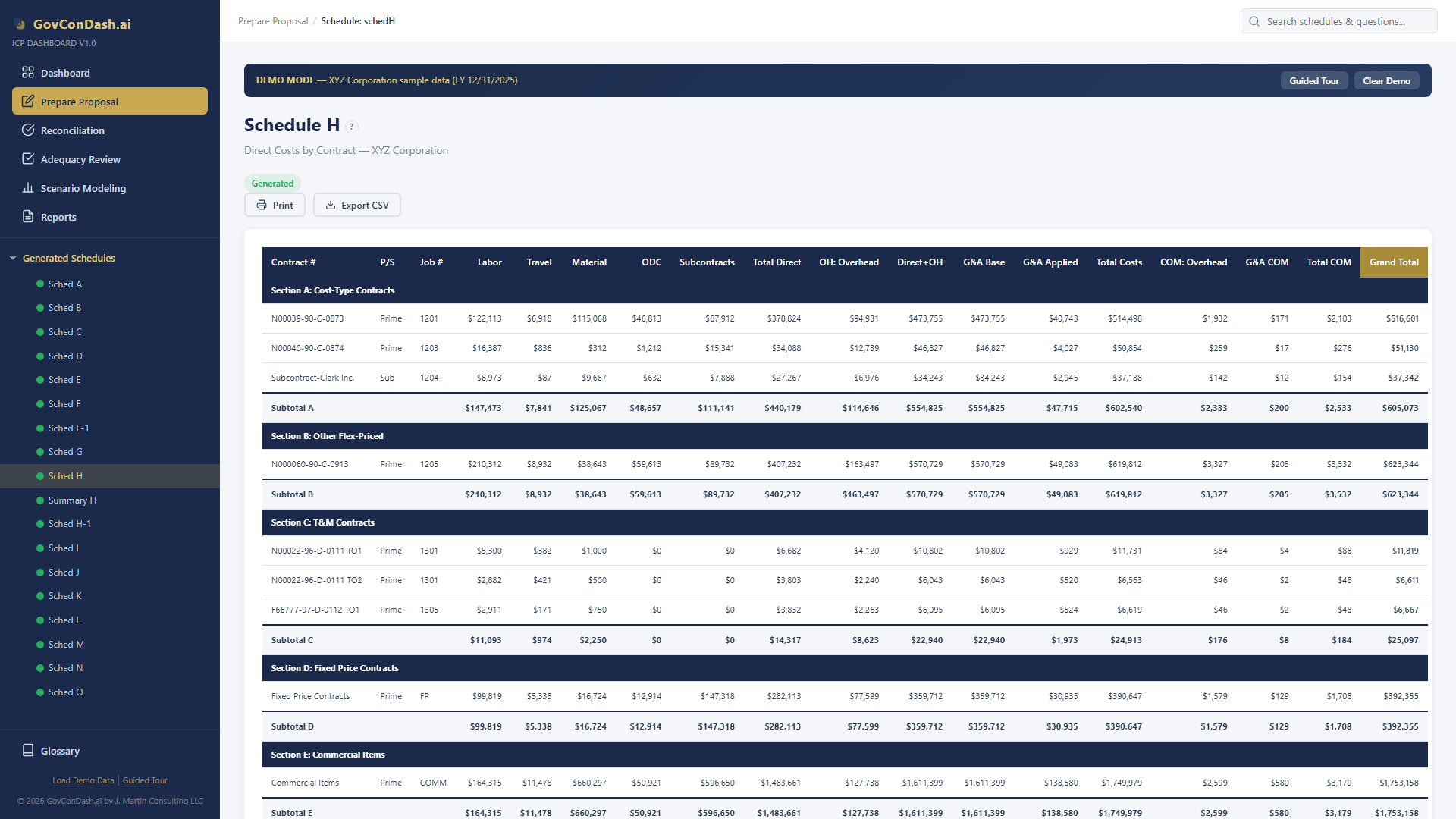
Direct Costs by Contract
23
Are the flexibly priced contracts and subcontracts, including commercial T&M, listed by contract and subtotaled by contract type?
Schedule H must list every contract individually, grouped into Sections A (Cost-Type), B (Other Flex), C (T&M), D (FFP), and E (Commercial).
24
Do subcontract costs incurred/claimed by contract tie to Schedule J?
Subcontract amounts on Schedule H must equal the corresponding detail on Schedule J for each contract.
25
Is the cost detail at the same level required by each contract, as specified in billing instructions?
Some contracts require CLIN-level detail. Check your billing instructions for the required cost breakdown level.
26
Were indirect expenses calculated using claimed rates from Schedule A?
Applied OH, G&A, and fringe on Schedule H must use exactly the rates shown on Schedule A. No provisional or budgeted rates.
27
Is the Government participation calculated for each indirect expense pool?
Schedule H-1 must show the government’s share of each indirect pool across contract sections.
28
Do base amounts used for calculating Government participation tie to Schedules E and H?
The bases used to compute government participation must reconcile back to allocation bases on Schedule E.
Schedule E — Allocation Bases
Schedule F — Cost of Money
Schedule G — Reconciliation
Schedule H — Direct Costs
07 — Schedules I & J
Cumulative Costs & Subcontracts: Questions 29–35
Schedule I tracks cumulative incurred costs across fiscal years with tie-outs to Schedules H, K, and O. Schedule J details all subcontract activity by prime contract.
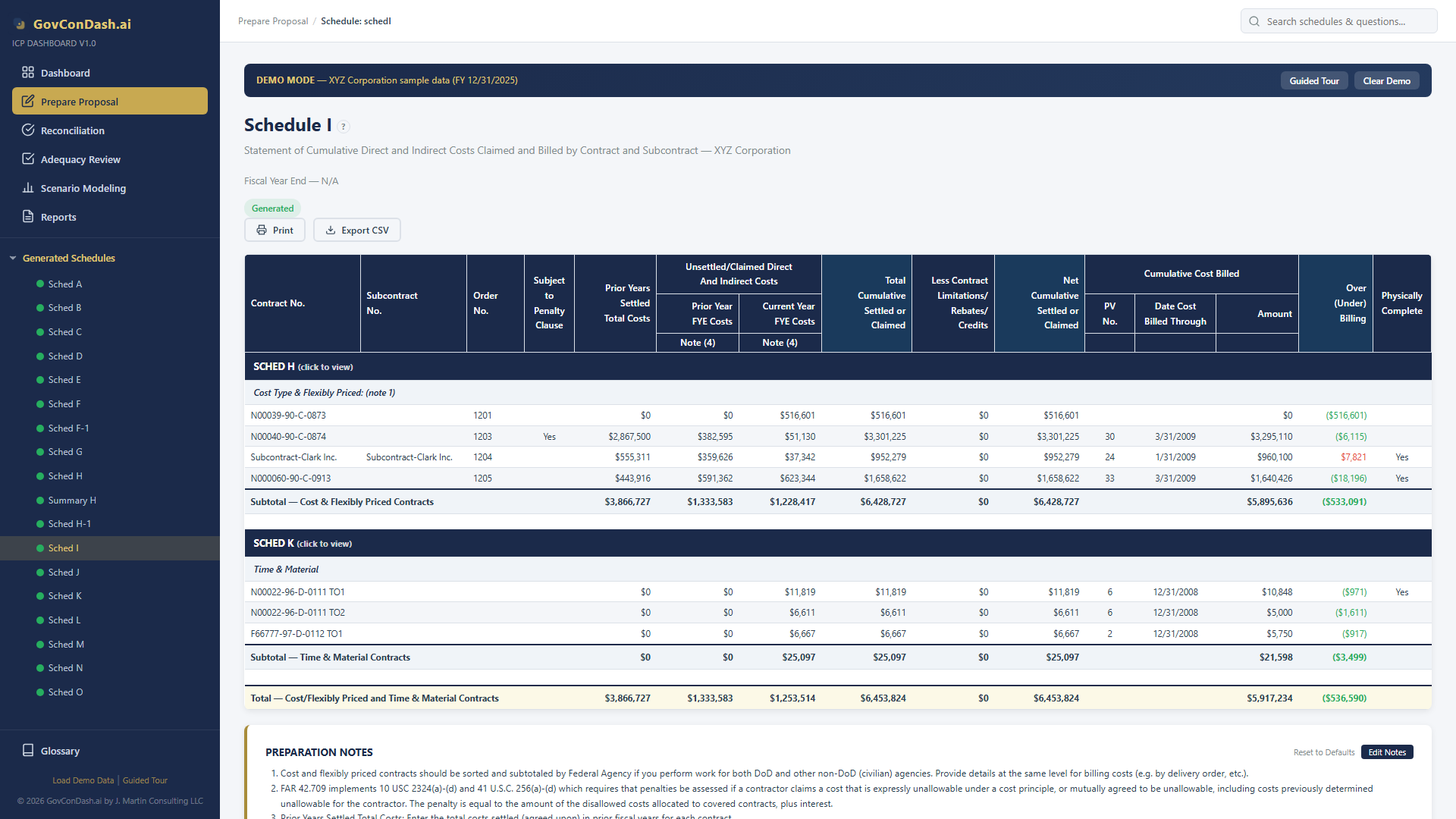
SCHED I
Cumulative Costs
29
Is the cost detail in the same level used for billing costs (e.g., by delivery order)?
Cumulative costs must match the billing detail level. If billing by delivery order, report at that level.
30
Do FY claimed dollars tie to Schedule H for cost type contracts?
Current FY amounts on Schedule I for cost-type contracts must equal Schedule H totals.
31
Do FY claimed dollars tie to Schedule K (not Sch. H) for T&M contracts?
T&M contract amounts on Schedule I tie to Schedule K, not H. A common mistake is referencing Schedule H for T&M.
32
Are prior years settled total costs the same as the prior year’s Cumulative Allowable Cost Worksheet?
Prior year settled amounts must match the CACW from the rate agreement letter. Retain all prior year CACWs.
33
Are contracts identified as physically complete reported on Schedule O?
Any contract flagged as physically complete on Schedule I must also appear on Schedule O with closing information.
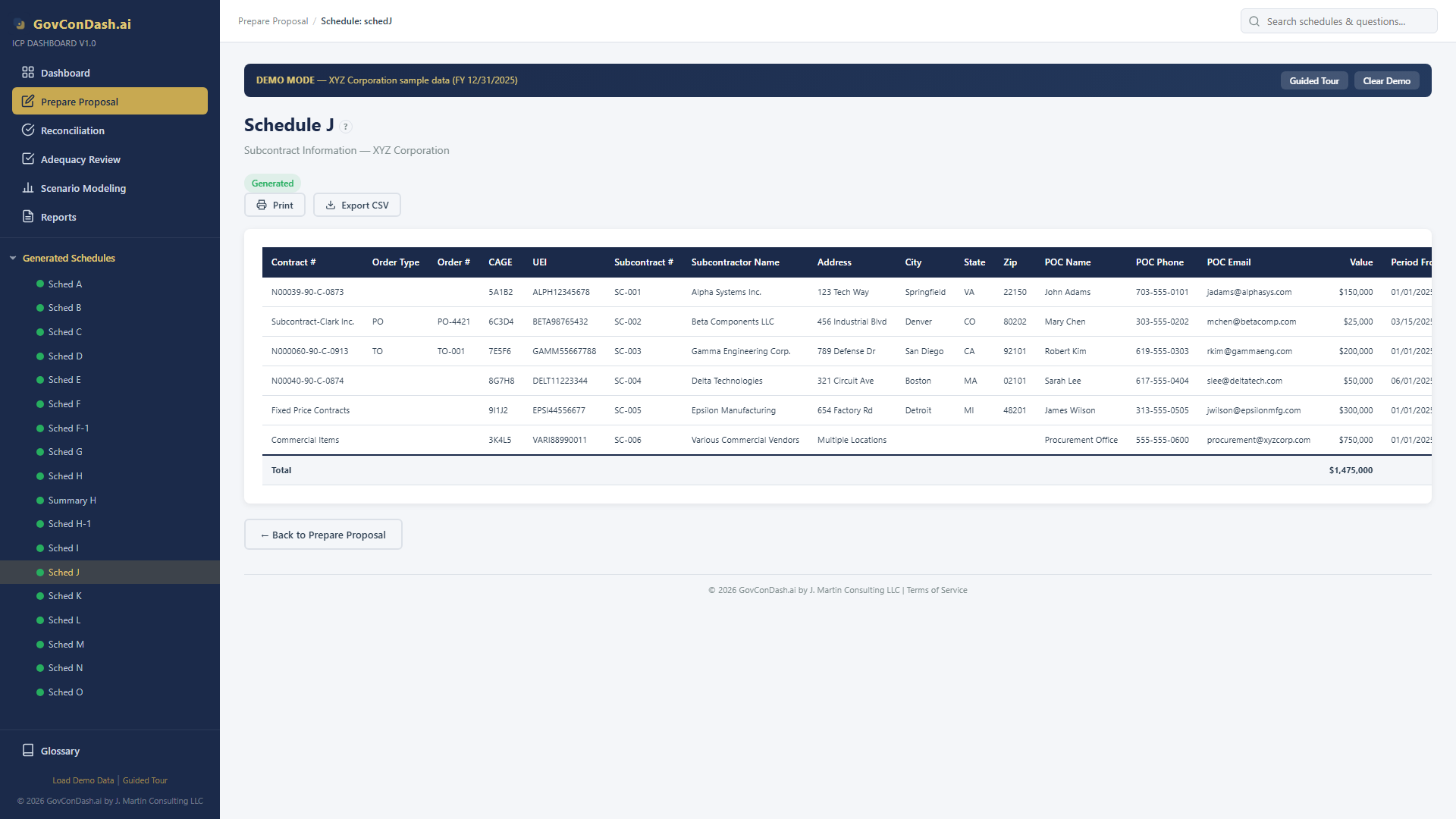
SCHED J
Subcontracts
34
Does the schedule include all types of subcontracts (cost-type, T&M/LH, IDIQ, FFP) and intercompany costs?
Every subcontract type must be reported, including intercompany work orders. Missing subcontracts trigger findings.
35
Did the contractor include all detail for the subcontracts (number, prime contract, name/address, POC, value, FY costs, award type)?
Each subcontract needs full detail: subcontract number, prime contract reference, vendor info, total value, FY costs, and contract type.
Schedule I — Cumulative Costs
Schedule J — Subcontracts
08 — Schedules K & L
T&M Contracts & Payroll: Questions 36–43
Schedule K breaks down Time & Materials and Labor Hour contracts by cost element and billing rate. Schedule L reconciles total payroll to labor distributed across direct, G&A, and overhead pools.
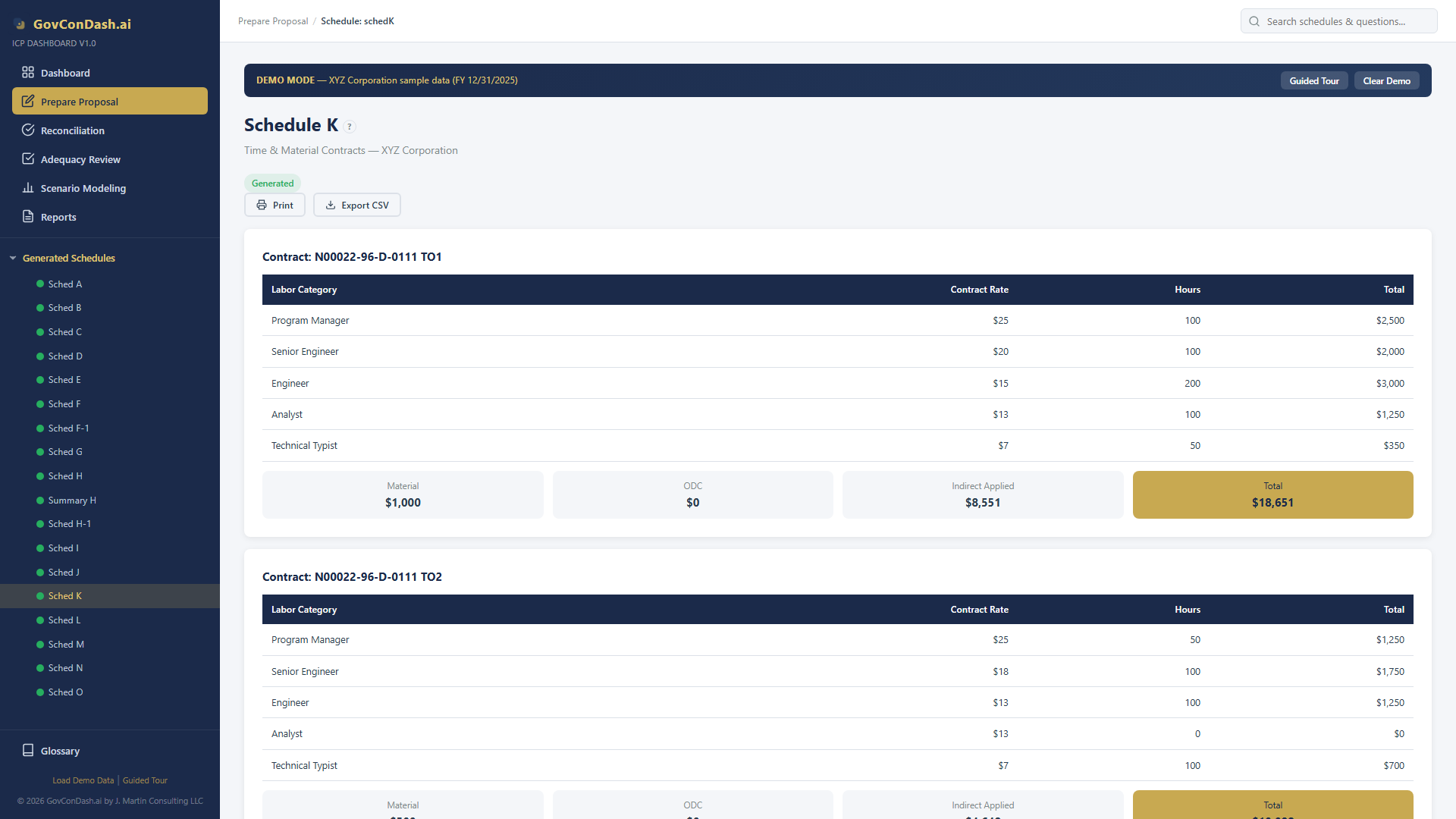
SCHED K
T&M / Labor Hour
36
Is the cost detail in the same level used for billing costs (e.g., by delivery order)?
T&M contract detail must match billing level granularity.
37
Are all contracts/delivery orders identified as T&M/LH on Schedule H reported on Schedule K?
Every T&M contract in Schedule H Section C must have a corresponding entry on Schedule K.
38
Is the information presented by cost element, with labor by category, showing contract labor rates (not actual rates) and billed hours?
Show contract billing rates (not actual cost rates) and hours by labor category. This is a frequent mistake.
39
Does the claimed indirect rate tie to Schedule A?
Indirect rates applied to T&M materials/ODCs must match the rates on Schedule A.
40
Does direct material and ODC claimed in Schedule K tie to Schedule H?
Material and other direct costs on Schedule K must equal the corresponding amounts on Schedule H.
SCHED L
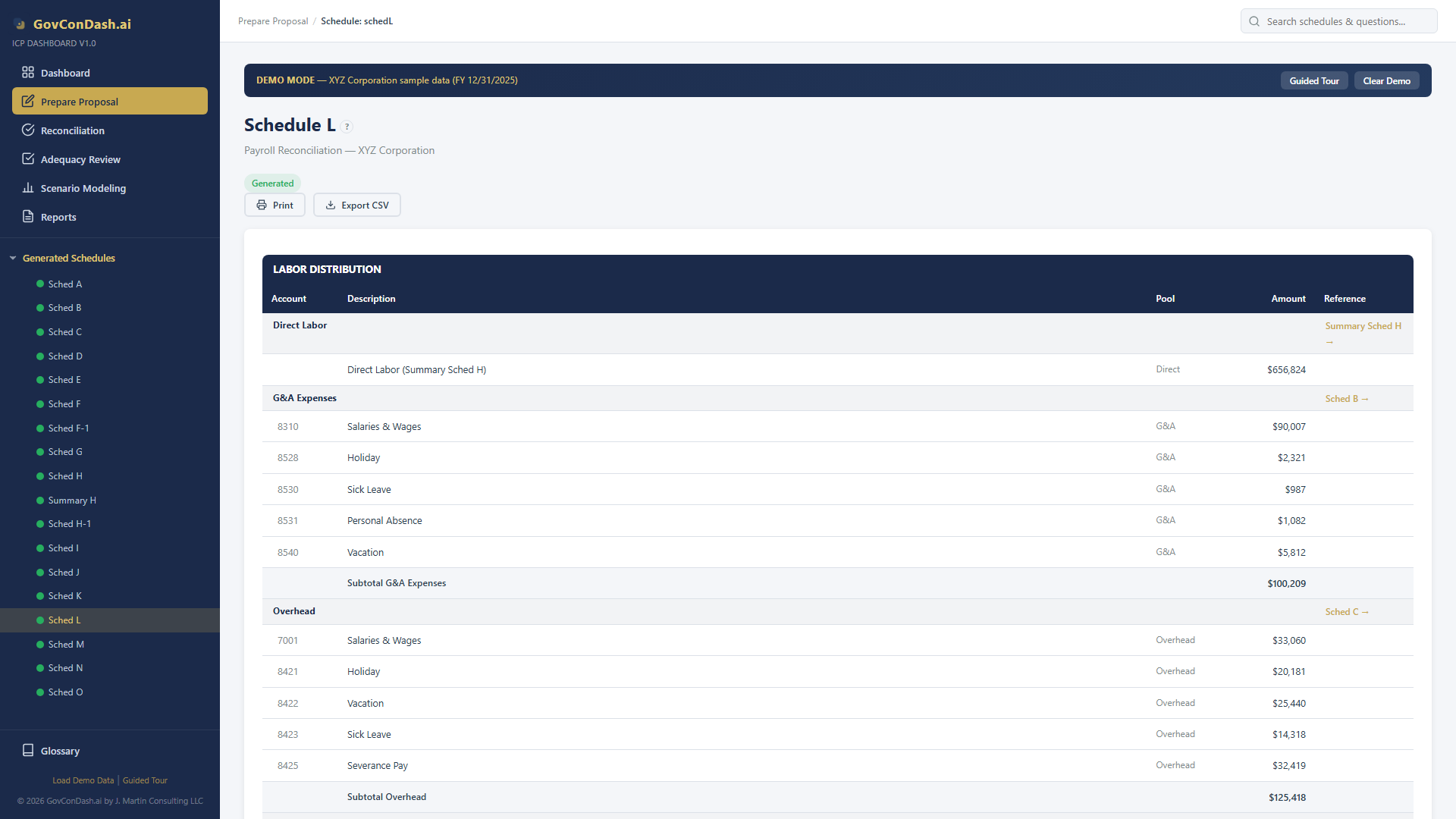
Payroll Reconciliation
41
Do direct labor totals tie to totals on Schedule H?
Direct labor distributed on Schedule L must equal direct labor claimed on Schedule H.
42
Do G&A labor totals tie to totals on Schedule B?
G&A labor on Schedule L must reconcile to the labor component on Schedule B.
43
Do other indirect pool labor totals tie to applicable pool schedules?
OH and intermediate pool labor on Schedule L must tie to Schedules C and D respectively.
Schedule K — T&M Contracts
Schedule L — Payroll Reconciliation
09 — Schedules M, N & O
Decisions, Certification & Contract Closing: Questions 44–47
The final four questions cover accounting changes and CAS noncompliance disclosures (M), the executive-level certificate of final indirect costs (N), and physically complete contract closing data (O).
SCHED M
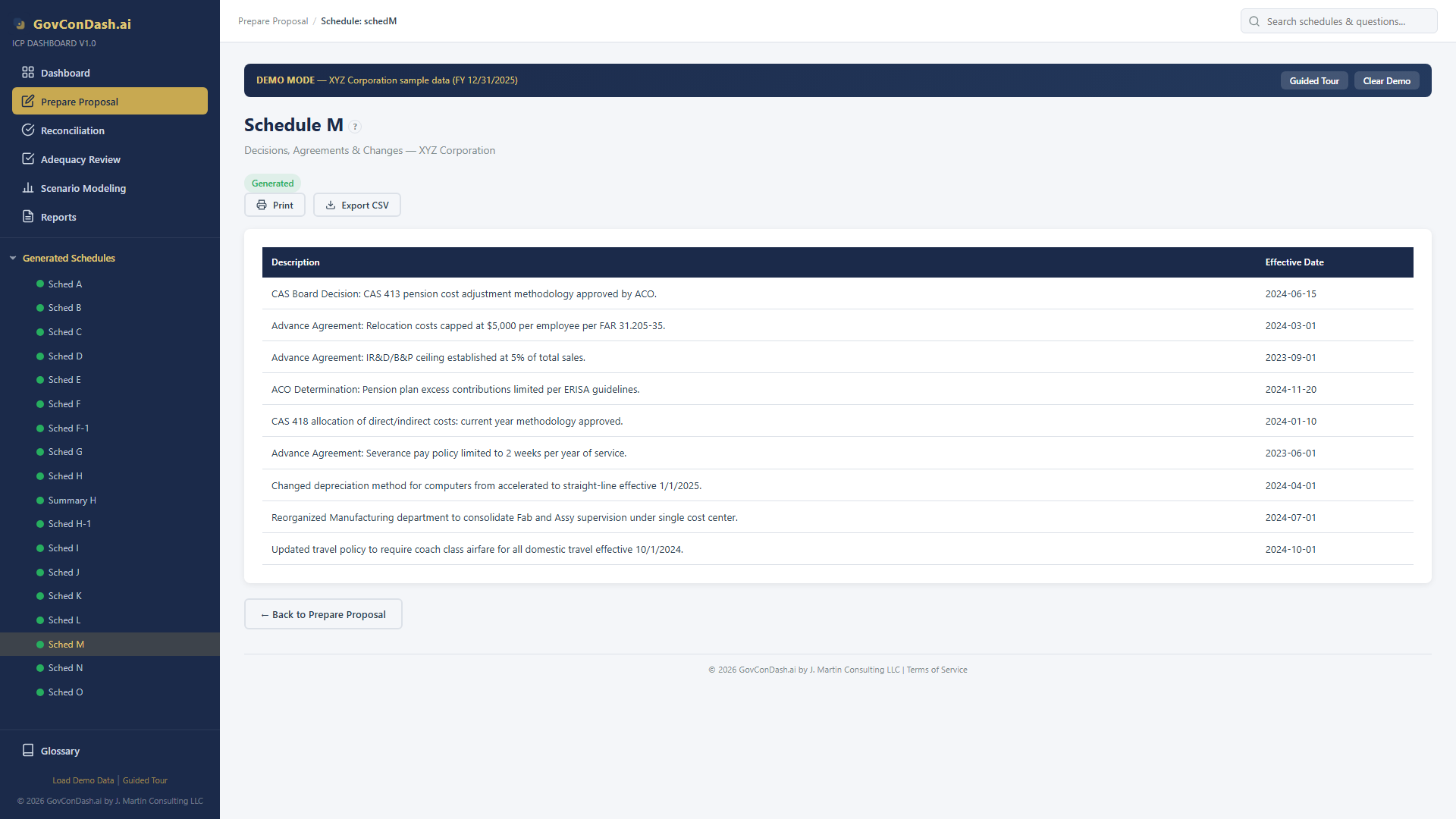
Accounting Changes & Decisions
44
Did the contractor provide a negative response if Schedule M was not completed?
Even if there are no decisions or changes to report, you must submit Schedule M with a “None” response.
SCHED N
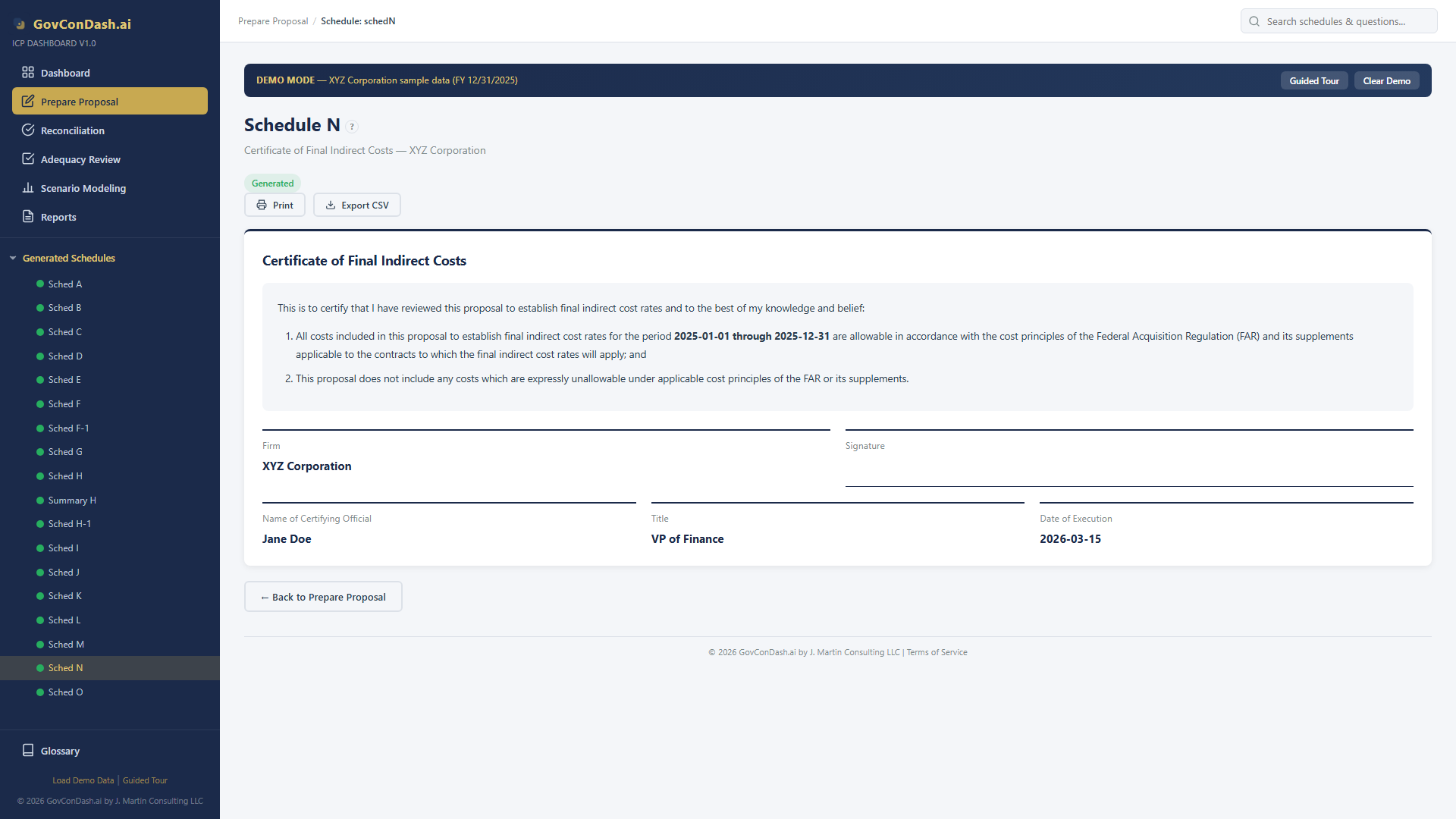
Certificate of Final Indirect Costs
45
Is the certificate signed by an individual at a level no lower than VP or CFO? (FAR 52.242-4(a))
The Schedule N certificate must be signed by a VP, CFO, or higher. A manager-level signature is insufficient.
SCHED O
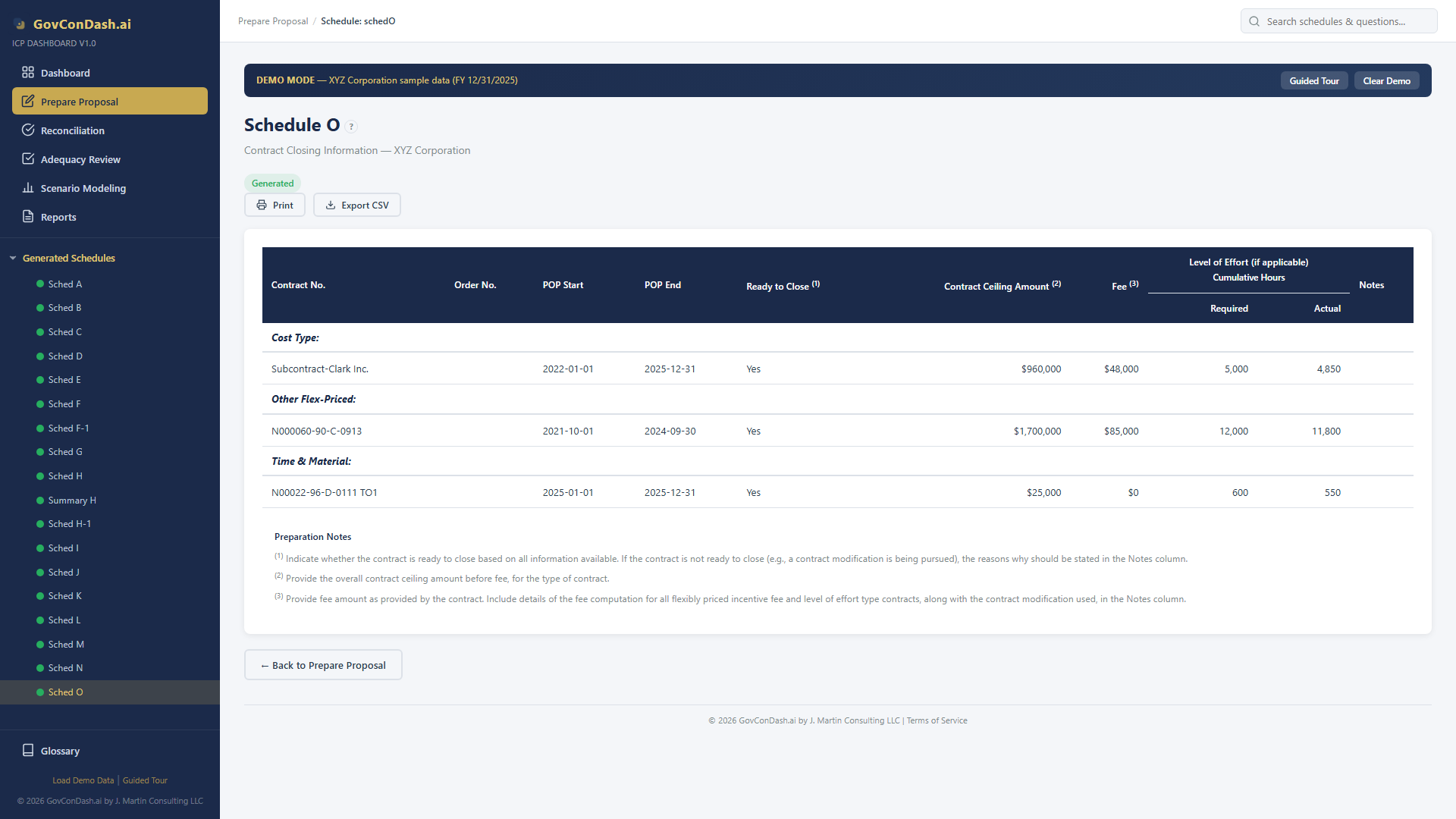
Contract Closing
46
Are contracts reported here identified as physically complete, already closed or ready to close on Schedule I?
Schedule O contracts must have the matching status flagged on Schedule I.
47
Does the schedule contain LOE information (planned and actual hours), contract fee computations, period of performance, and contract ceiling amounts?
Schedule O requires complete closing detail: LOE hours, fee calculations, PoP dates, and ceiling amounts for each closing contract.
Schedule M — Management Decisions
Schedule N — Certification
Schedule O — Contract Closing
10 — Smart Automation
How the Dashboard Auto-Verifies
The ICP Dashboard automates the verification behind many checklist questions. When you generate schedules, cross-schedule checks run automatically and feed results into your adequacy assessments.

Generate Schedules

One-click generation
computes all 15+
ICE schedules

Cross-Schedule Checks

Automated tie-outs
verify A↔B, A↔C,
A↔E, H↔B, H↔L

Auto-Populate Checklist

Passing checks
pre-fill Received=Y
and Adequate=Y

Export Report

One-click Excel export
of all 47 assessments
with comments

Smart Validation Engine

FAR 31.205 unallowable cost detection, completeness audit, math consistency checks, and negative balance flags all feed into checklist assessments.

$1 Tolerance Matching

Cross-schedule tie-outs use the same $1 tolerance as DCAA auditors, matching the precision standard applied during actual adequacy reviews.

Risk Scoring

High-risk questions (like Q10 IR&D/B&P fringe, Q31 T&M tie-out, Q45 certificate level) are flagged with elevated attention during review.

Adequacy Auto-Populate

Ready to Pass Adequacy?

Stop worrying about missed tie-outs and incomplete schedules. The ICP Dashboard tracks all 47 questions, auto-verifies cross-schedule consistency, and exports a complete adequacy report — all in your browser.

IncurredCostProposal.com