Overhead costs support the direct execution of two or more contracts. Examples include facilities, maintenance, IT support, operational supplies, indirect labor, and equipment depreciation — costs that benefit multiple cost objectives but are not directly identifiable to a single contract per FAR 31.203.
FAR 31.203 governs indirect cost allocation. CAS 418 requires that the allocation base represent the activity that causes or generates the overhead costs.
Overhead is applied to contracts before G&A. The overhead amount then becomes part of the G&A allocation base (TCI or Value Added), making the overhead rate a critical input to the entire rate structure.
The most common overhead base is direct labor cost. Overhead is typically allocated to contracts in proportion to the direct labor each contract incurs, reflecting the labor-driven nature of most overhead costs.
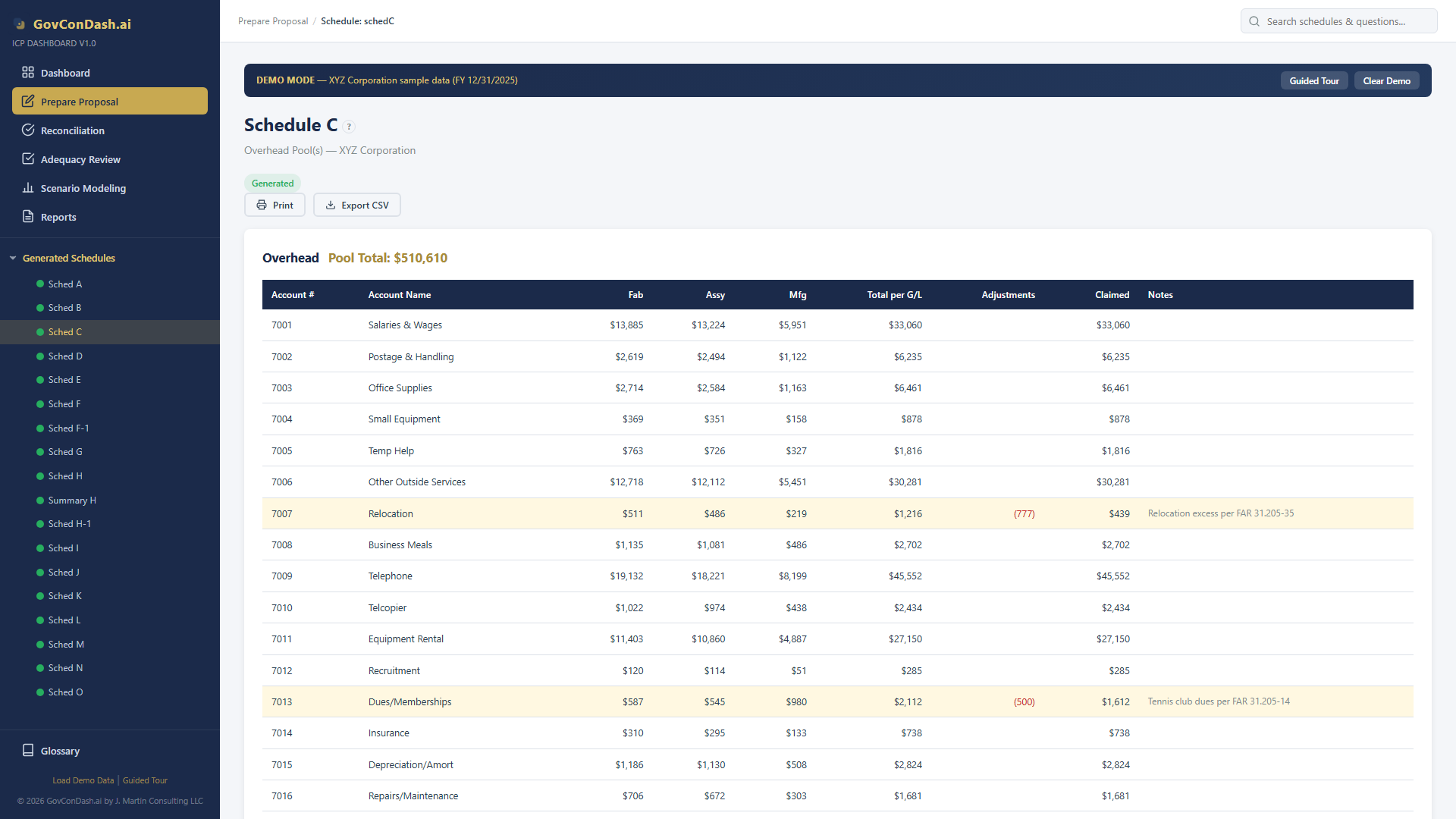
All overhead expenses are accumulated on Schedule C of the ICP. The dashboard supports up to 6 overhead pools (e.g., Engineering Overhead, Manufacturing Overhead), each with its own pool, base, and rate on Schedule C(1) through C(6).
Applied overhead on IR&D/B&P contracts flows into the G&A pool (Schedule B). The overhead rate must be stable before G&A can be computed, making it a foundational building block of the entire rate structure.
Overhead expense accounts
+ intermediate allocations
= Overhead Pool (numerator)
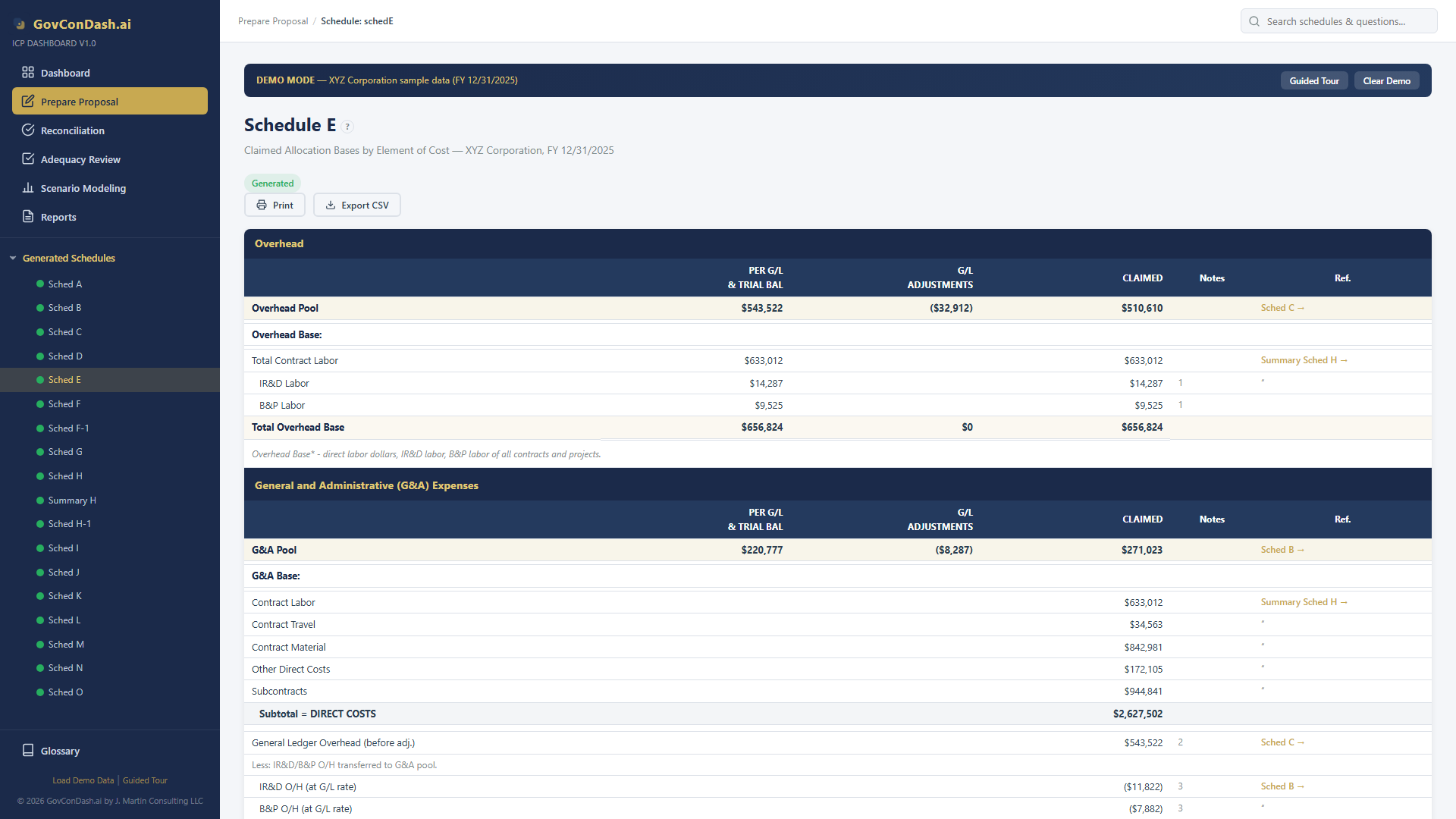
Overhead allocation base
Direct labor + fringe
+ IR&D/B&P labor
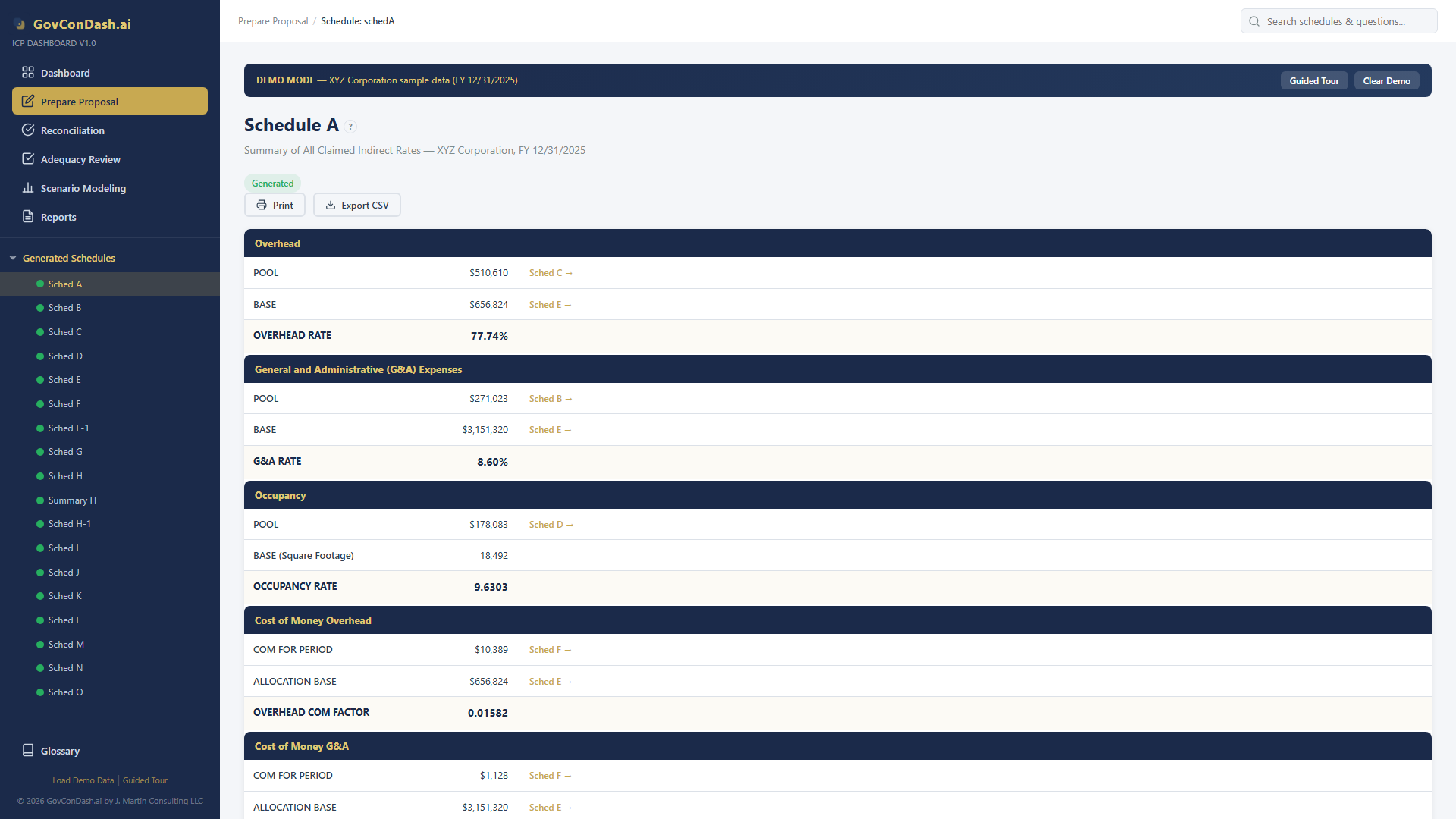
Expressed as %
rounded to 4 decimals
(e.g., 77.74%)
Applied to each
contract's labor base
(+ fringe if in base)
All accounts classified as overhead in the chart of accounts, plus any intermediate pool allocations (e.g., occupancy allocated to Overhead). Adjustments for unallowable costs are netted here.
The overhead base sums direct contract labor from Schedule H sections, plus IR&D/B&P labor. When fringe is configured "in overhead base," fringe amounts are added to the denominator.
The overhead rate is computed to 4 decimal places as a percentage. This rate appears on Schedule A and is applied to every labor-bearing contract on Schedule H.
The overhead pool captures indirect costs that benefit multiple cost objectives. These costs must be allocated because they cannot be directly traced to any single contract or task order.
The overhead base is assembled from Schedule H by summing direct labor costs across all contract sections, plus IR&D/B&P labor. Configuration options control whether fringe is included in the base.
The overhead pool (Schedule C grand total) divided by the overhead base (Schedule E), rounded to 4 decimal places and expressed as a percentage. Each pool has its own rate.
Direct labor from all contract sections (A through E on Schedule H) plus IR&D/B&P labor. This is the default configuration when fringe is not in the overhead base.
When the "fringe in overhead base" flag is enabled, applied fringe amounts are added to the labor base. This produces a lower overhead rate percentage but a broader allocation base.
Each contract's direct labor (plus fringe if in base) is multiplied by the overhead rate. The result appears as "Applied Overhead" on Schedule H for every labor-bearing contract.
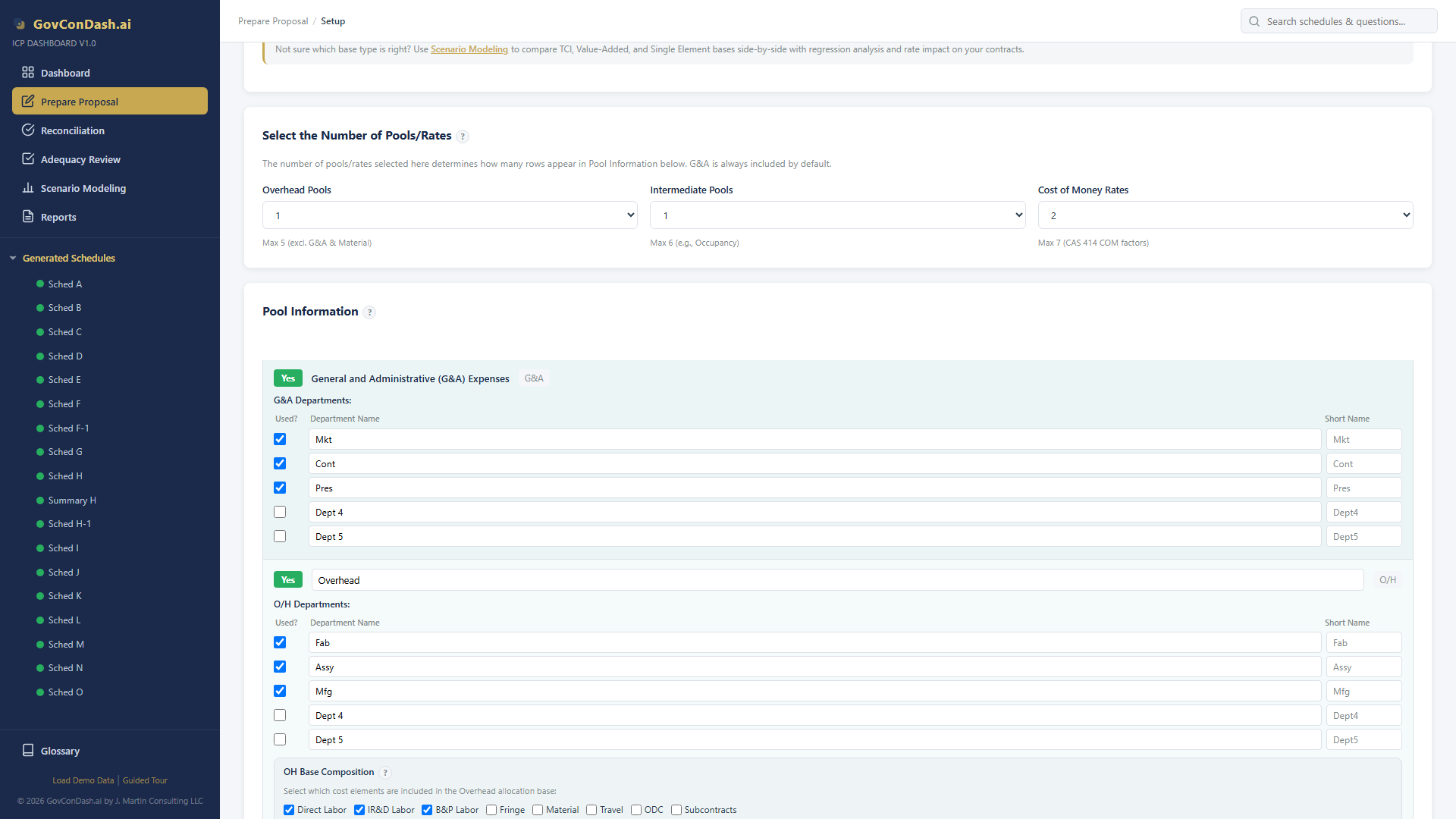
Intermediate pools (occupancy, IT, etc.) are allocated to overhead based on square footage, headcount, or other bases per Schedule D. These allocations increase the overhead pool total.
IR&D/B&P activities receive overhead at the per-G/L rate (not the claimed rate) to break the circular dependency. The overhead rate is stable since it has no G&A dependency.
The most common structure for professional services contractors. Fringe benefits are broken out as their own indirect rate, separate from overhead and G&A. This is the industry standard preferred by DCAA auditors and contracting officers.
Some contractors, particularly smaller firms, bundle fringe costs into the overhead pool. This simplifies the rate structure to just two tiers (Overhead + G&A) but produces a significantly higher overhead rate.
A single overhead pool works when all contracts consume overhead resources at roughly the same rate relative to their direct labor. Multiple pools become necessary when different functions have materially different cost structures.
The ICP Dashboard supports up to 6 overhead pools configured during Setup (Step 1). Each pool gets its own Schedule C sub-sheet, its own section on Schedule E, and its own rate on Schedule A.
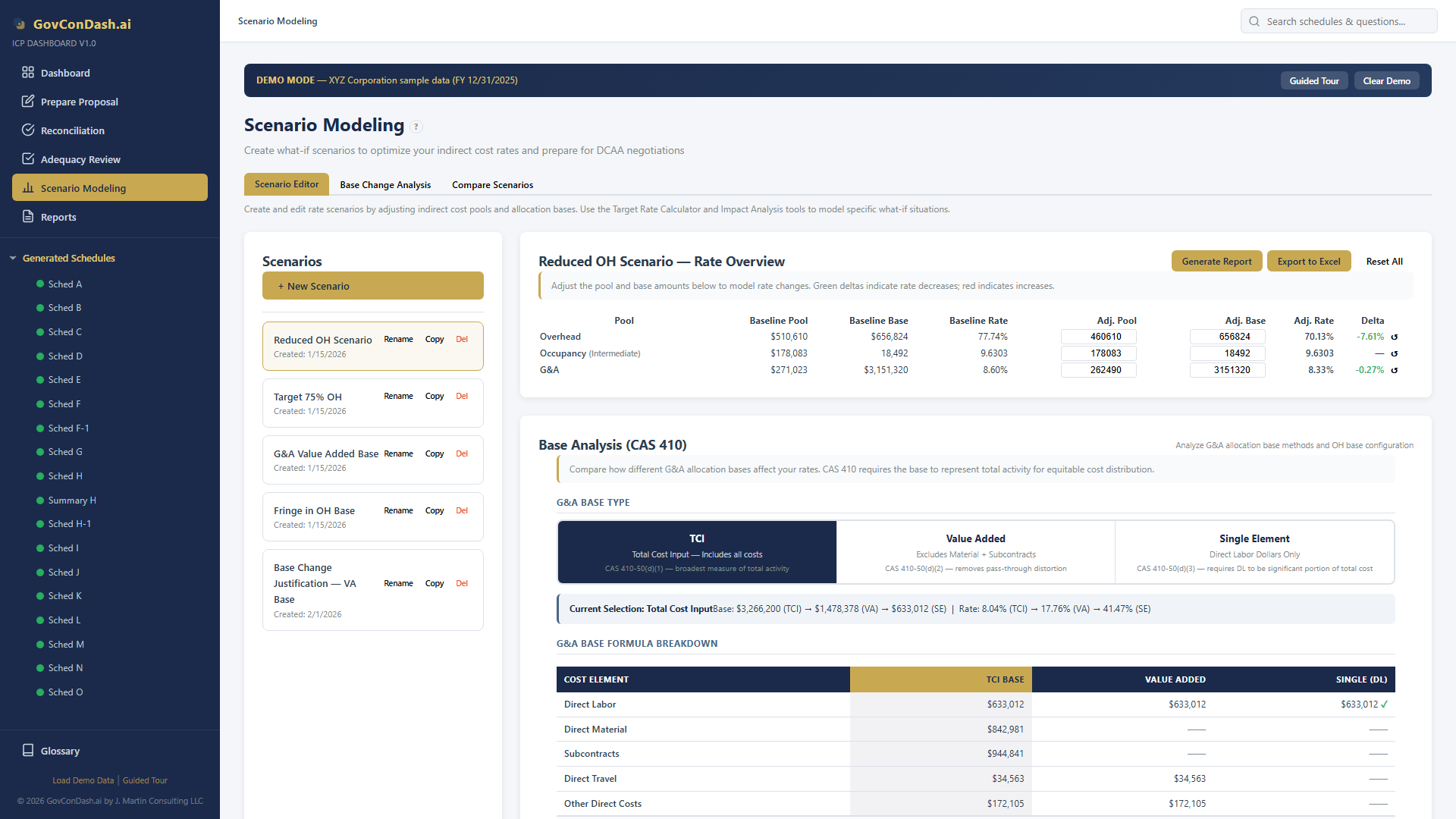
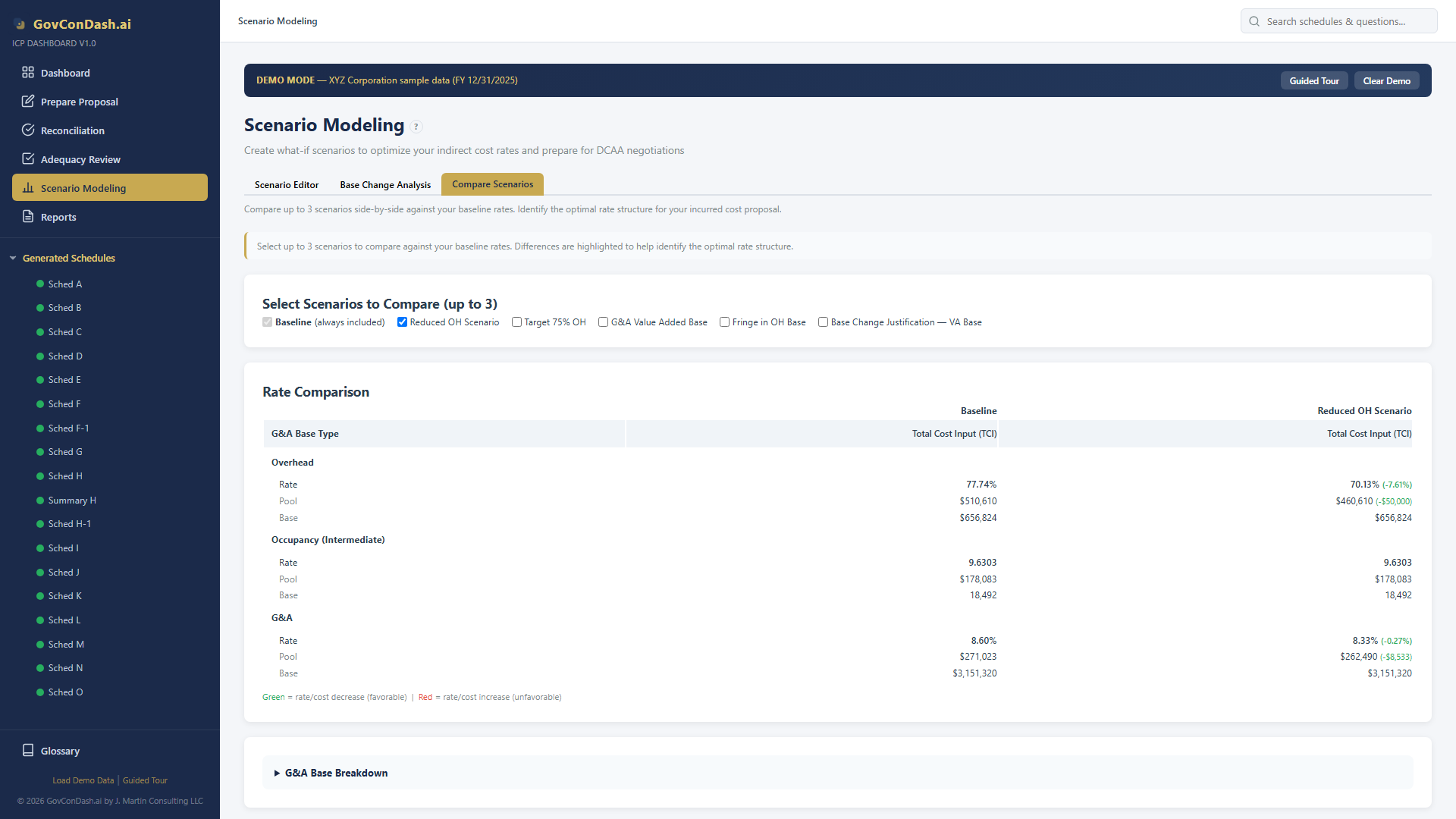
Because the overhead rate feeds into the G&A base, any change to overhead has cascading effects across the entire rate structure. Scenario modeling lets you see these effects before committing.
The overhead rate is uniquely important because it sits in the middle of the rate structure. Changes propagate both upstream (to IR&D/B&P allocations) and downstream (to the G&A base and total contract costs).
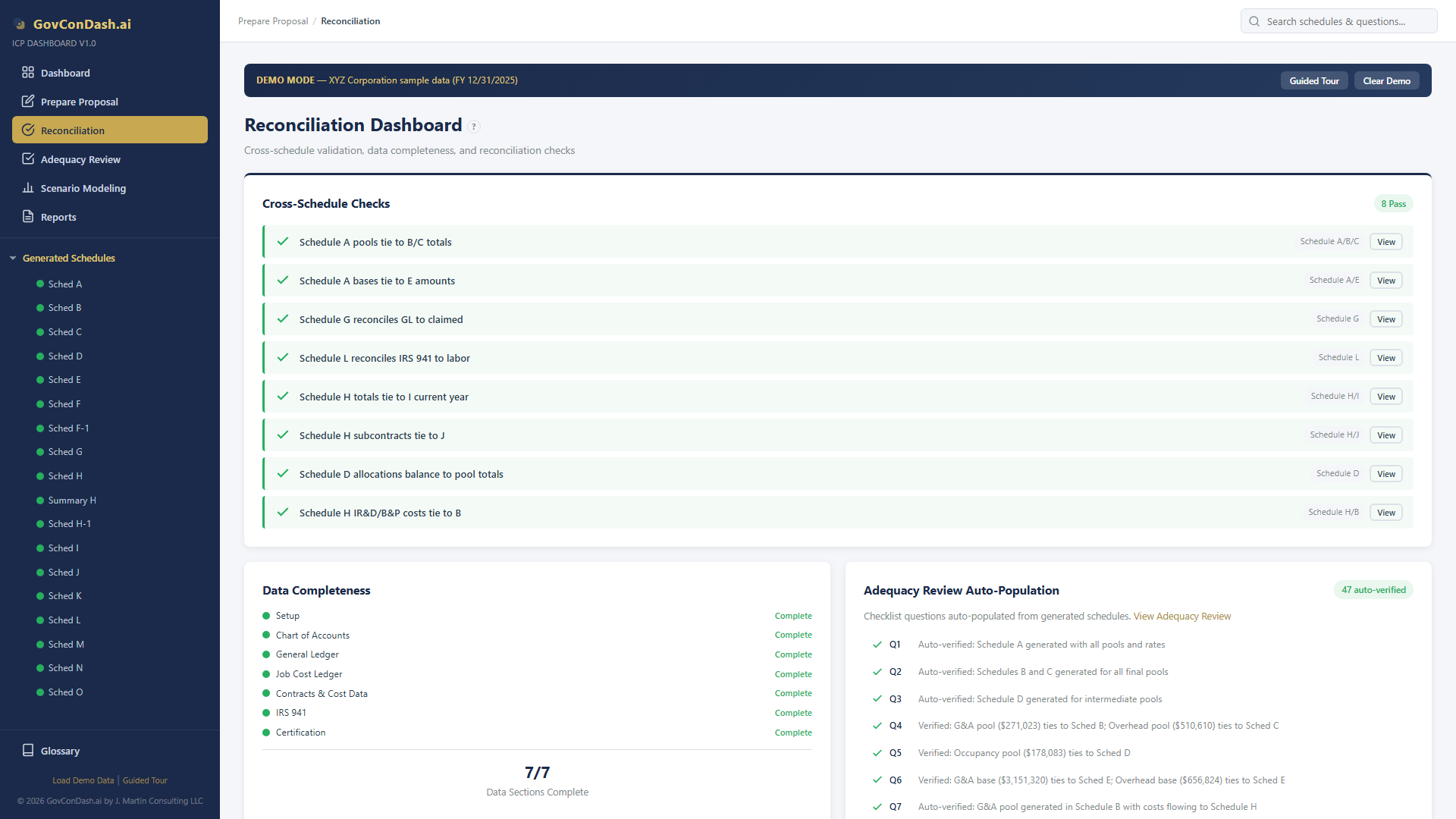
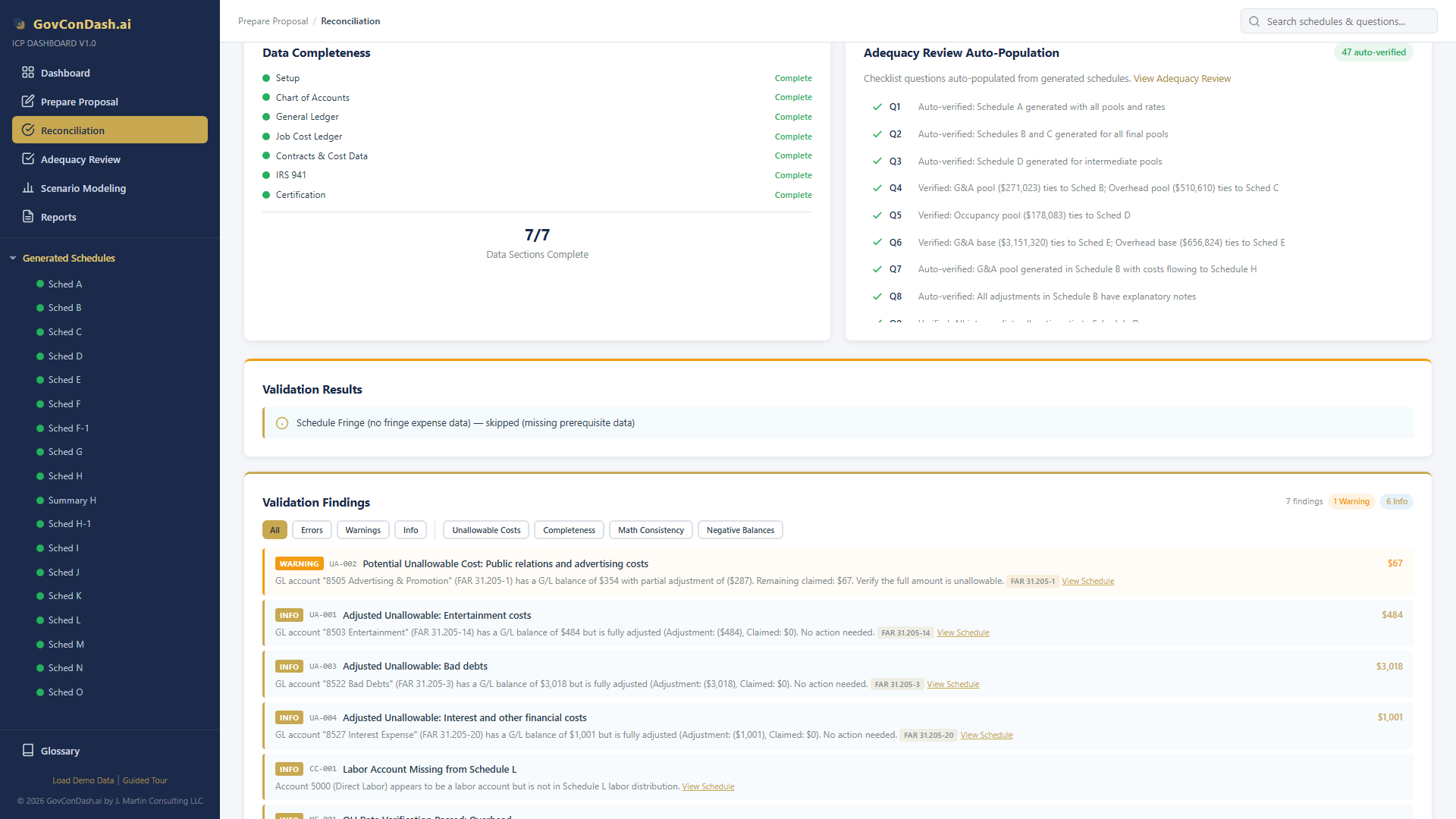
The dashboard automatically verifies that Schedule C (pool), Schedule E (base), and Schedule A (rate) are internally consistent. Any variance greater than $1 is flagged as an error.
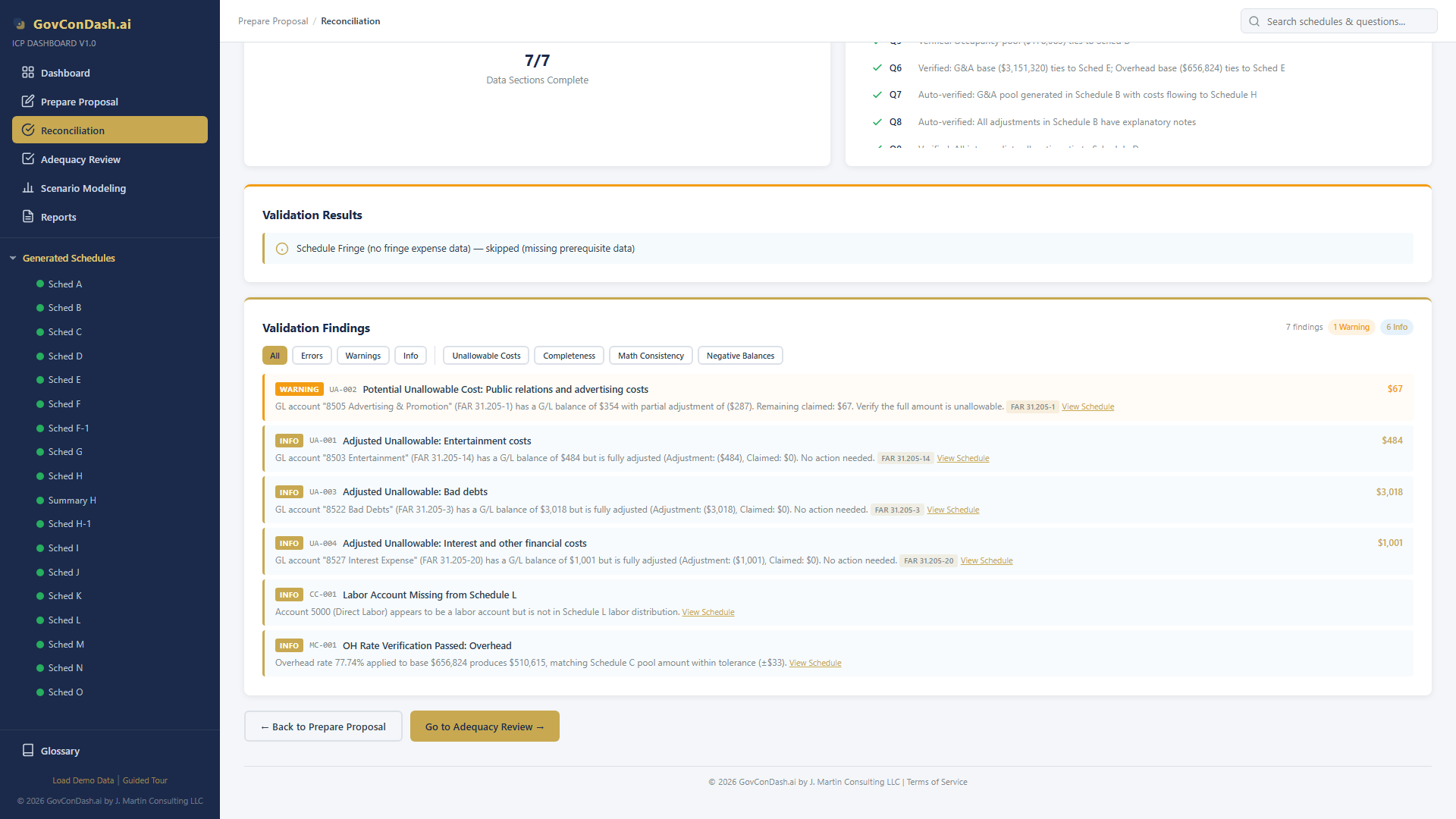
The Smart Validation Engine scans overhead accounts against 21 FAR 31.205 keyword categories to detect potentially unallowable costs in the overhead pool. It also checks data completeness and flags negative balances.
The dashboard includes the 47-question DCAA Adequacy Checklist (v3.4). Several questions specifically address overhead schedules C and E. Reconciliation results can auto-populate checklist answers.
Charging costs as overhead that should be direct (or vice versa) distorts the overhead rate. FAR 31.202 requires that costs directly identifiable to a contract must be charged direct.
overhead accounts must use the exact pool name from setup configuration (e.g., "Engineering Overhead" not "Overhead"). Mismatched names cause accounts to be excluded from the pool computation entirely.
Entertainment, alcohol, and other FAR 31.205 unallowable costs left in the overhead pool inflate the rate. The Smart Validation Engine flags these automatically.
If occupancy or other intermediate pools should be allocated to overhead (per Schedule D), omitting this allocation understates the overhead pool and produces an artificially low rate.
The "fringe in overhead base" setting must be applied consistently across fiscal years. Changing this configuration mid-stream without a disclosure statement change violates CAS 401 consistency requirements.
IR&D/B&P labor must be included in the overhead base on Schedule E. Excluding it understates the base and overstates the overhead rate applied to direct contracts.
Schedule C (pool) divided by Schedule E (base) must equal Schedule A (rate). A $1+ variance triggers an automatic DCAA adequacy failure. The dashboard verifies this automatically.
Using one overhead pool when different functions have materially different cost structures violates CAS 418 homogeneity requirements and can cause cross-subsidization between contract types.
The ICP Dashboard automates overhead pool accumulation, base computation, rate calculation, intermediate pool allocations, and cross-schedule reconciliation — with built-in what-if scenario modeling and multi-pool support.
GovConDash.ai