FAR & CAS
Compliance Guide

The Complete Regulatory Framework Governing Government Contractor Cost Accounting — Every Standard, Every Rule, One Reference
19
CAS Standards
50+
FAR Cost Principles
6
Categories
3
Coverage Levels
01 — Two Frameworks, One System
FAR Meets CAS
Government contractor cost accounting is governed by two complementary regulatory frameworks. The Federal Acquisition Regulation (FAR) defines what costs are allowable. The Cost Accounting Standards (CAS) define how costs must be allocated. Together, they form the compliance foundation for every Incurred Cost Proposal (ICP).

FAR Part 31

“What can I charge?”

The Federal Acquisition Regulation Part 31 establishes cost principles that determine whether a cost is allowable, allocable, and reasonable for government contract purposes.

  • Allowability — Is this cost permitted under FAR 31.205?
  • Allocability — Does it benefit a specific contract or the business?
  • Reasonableness — Would a prudent person pay this amount?
  • CAS Conformance — Does it follow CAS if applicable?
  • Contract Terms — Are there any specific limitations?

CAS (48 CFR Chapter 99)

“How do I charge it?”

Cost Accounting Standards prescribe accounting methods for measuring, assigning, and allocating costs to government contracts. CAS ensures consistent treatment across all cost objectives.

  • Consistency — Bid = Book = Bill (CAS 401)
  • Same Purpose — Like costs treated alike (CAS 402)
  • Allocation Method — Causal-beneficial relationship (CAS 418)
  • G&A Base Selection — Represent total activity (CAS 410)
  • Disclosure — Document practices in DS-1 (Full CAS)
Key Insight

FAR and CAS are complementary, not redundant. A cost can be allowable under FAR but improperly allocated under CAS (or vice versa). Compliance with both frameworks simultaneously is required. FAR tells you the boundaries; CAS tells you the mechanics.

02 — FAR Foundation
The FAR Cost Architecture
FAR Part 31 is organized into subparts and sections that together form the rules for cost allowability, allocation, and reasonableness. These are the key provisions every contractor must know.

FAR 31.201-2

Determining Allowability — the five-part test: reasonable, allocable, CAS-conformant, limited/excluded per 31.205, and consistent with contract terms.

💰

FAR 31.203

Indirect Costs — governs how indirect costs are pooled, how allocation bases are selected, and when intermediate pools or service centers are warranted.

📝

FAR 31.205

Selected Costs — 50+ cost categories with specific allowability rules. The heart of “what can I charge?” from compensation to travel to depreciation.

📄

FAR 52.216-7

Allowable Cost and Payment — the contract clause that triggers the ICP requirement. Requires submission within 6 months of fiscal year end.

FAR 31.201-3

Reasonableness — would a prudent person incur this cost in a competitive environment? Considers the nature, amount, and the contractor’s responsibilities.

🚫

FAR 31.201-6

Accounting for Unallowable Costs — requires identification and segregation. Unallowable costs must be excluded from indirect cost pools but remain in allocation bases.

03 — CAS Coverage Levels
Who Must Comply? Coverage Tiers
Your CAS coverage level determines which of the 19 standards apply. The NDAA 2026 §1806 significantly raised the thresholds — many mid-size contractors are now exempt or under Modified coverage.
Full CAS

Full Coverage

Awards ≥ $100M (was $50M)
  • All 19 CAS standards apply
  • Disclosure Statement (CASB DS-1) required
  • Any accounting change requires revised DS and cost impact proposal
  • Coverage remains for life of contract
  • Requires FAR 52.230-2 clause in contract
Modified CAS

Modified Coverage

≥ $35M and < $100M per contract (was $2.5M)
  • Only CAS 401, 402, 405, 406 apply
  • Disclosure Statement normally not required
  • Requires FAR 52.230-3 clause in contract
  • Many mid-size contractors now fall below this threshold
  • Coverage remains for life of contract
Exempt

CAS Exempt

Below thresholds or excluded types
  • Negotiated contracts < $35M
  • Sealed bid contracts
  • Small business concerns
  • FFP contracts for commercial items
  • FFP awarded on adequate price competition
  • Still must comply with FAR 31 cost principles
NDAA 2026 §1806 — Key Changes
  • Full CAS threshold doubled: $50M → $100M (adjusted for inflation per 41 USC §1908)
  • CAS contract-level exemption threshold 14x increase: $2.5M → $35M per contract (Modified CAS now applies in the $35M–$100M range)
  • FFP cost recovery barred: Govt cannot recover CAS-related costs from firm-fixed-price contracts or non-cost-redetermination contracts
  • Cost recovery capped: Limited to net increased costs paid for all accounting practice changes implemented during that year
  • 48 CFR 9903.201-2 update due by June 16, 2026 (180 days); DFARS update due by April 17, 2026 (120 days). Threshold increases effective for contracts entered into after June 30, 2026.
04 — CAS Standards Reference
All 19 CAS Standards by Category
The Cost Accounting Standards are organized into six functional categories. Each standard addresses a specific aspect of cost measurement, accumulation, or allocation. Understanding the category helps you grasp the standard’s purpose.

Consistency (2)

CAS 401 — Estimating, accumulating, and reporting costs must be consistent (Bid = Book = Bill).
CAS 402 — Costs incurred for the same purpose must be treated consistently as either direct or indirect.

General Accounting (3)

CAS 405 — Accounting for unallowable costs (segregation).
CAS 406 — Cost accounting period definition.
CAS 407 — Use of standard costs for direct material and labor.

📈

Cost Allocation (5)

CAS 403 — Home office to segments.
CAS 410 — G&A to final cost objectives.
CAS 418 — Direct and indirect cost allocation.
CAS 420 — IR&D and B&P costs.
CAS 411 — Acquisition costs of material.

🏢

Property (2)

CAS 404 — Capitalization of tangible assets (capitalization thresholds and service life).
CAS 409 — Depreciation of tangible capital assets (methods, useful life, residual value).

Compensation (5)

CAS 408 — Compensated personal absences.
CAS 412/413 — Pension cost (composition and allocation).
CAS 415 — Deferred compensation.
CAS 416 — Insurance costs.

💰

Cost of Money (2)

CAS 414 — Facilities capital cost of money (semi-annual Treasury rates, net book value).
CAS 417 — Cost of money for capital assets under construction.

05 — The Complete Reference
CAS ↔ FAR Cross-Reference
Every CAS standard maps to specific FAR provisions. This table shows the complete relationship — the CAS standard, its purpose, the corresponding FAR reference, the coverage level required, and which ICE schedule is affected.
Category CAS Standard Title FAR Reference Coverage ICE Schedule
Consistency 401 Consistency in Estimating, Accumulating & Reporting 31.201-1, 31.201-2 Full + Modified All Schedules
402 Consistency in Allocating Costs for the Same Purpose 31.202, 31.203 Full + Modified B, C, H
General 405 Accounting for Unallowable Costs 31.201-2, 31.201-6 Full + Modified B, C
406 Cost Accounting Period 31.203 Full + Modified Setup
407 Use of Standard Costs for Direct Material & Labor 31.201-1 Full Only H, I, J
Cost Allocation 403 Home Office Expenses to Segments 31.203, 31.201-4 Full Only B, C, D
410 G&A Expenses to Final Cost Objectives 31.203, 31.201-4 Full Only A, B, E
418 Allocation of Direct and Indirect Costs 31.203, 31.201-4 Full Only A, E, H
420 IR&D and B&P Costs 31.205-18 Full Only B, H
411 Acquisition Costs of Material 31.205-26 Full Only H, I
Property 404 Capitalization of Tangible Assets 31.205-11 Full Only F-1
409 Depreciation of Tangible Capital Assets 31.205-11 Full Only B, C, F-1
Compensation 408 Compensated Personal Absences (PTO, Holiday) 31.205-6 Full Only B, C, Fringe
412 Composition & Measurement of Pension Cost 31.205-6(j) Full Only B, C, Fringe
413 Adjustment & Allocation of Pension Cost 31.205-6(j) Full Only B, C
415 Cost of Deferred Compensation 31.205-6 Full Only B, C
416 Insurance Costs 31.205-19 Full Only B, C
Cost of Money 414 Facilities Capital Cost of Money 31.205-10 Full Only A, F, F-1
417 Cost of Money — Capital Assets Under Construction 31.205-10 Full Only F, F-1
Reading the Table

Full + Modified means the standard applies to both Full CAS and Modified CAS contractors (CAS 401, 402, 405, 406). Full Only means only contractors with Full CAS coverage must comply. ICE Schedule shows which schedule in the incurred cost proposal is directly affected by that standard. The FAR Reference column maps each CAS standard to the specific FAR cost principle it supports.

06 — The Allowability Test
FAR 31.205 Selected Costs & CAS Interplay
FAR 31.205 contains 50+ cost categories. Each has specific allowability rules that interact with CAS requirements. These are the most commonly audited categories and their CAS connections.

Compensation Conditional

FAR 31.205-6 ↔ CAS 408, 412, 413, 415

Salaries, wages, bonuses, PTO, pensions, deferred comp. Must be reasonable and comply with CAS measurement and allocation rules. Top DCAA audit target.

Depreciation Allowable

FAR 31.205-11 ↔ CAS 404, 409

Depreciation on tangible assets. CAS 404 governs capitalization thresholds; CAS 409 governs depreciation method, useful life, and residual value.

Entertainment Unallowable

FAR 31.205-14 ↔ CAS 405

Always unallowable. CAS 405 requires these costs to be identified and segregated in the accounting system. Must be excluded from indirect cost pools.

IR&D / B&P Conditional

FAR 31.205-18 ↔ CAS 420

Allowable if reasonable. CAS 420 dictates how IR&D and B&P costs are accumulated and allocated to final cost objectives through the G&A pool.

Insurance Conditional

FAR 31.205-19 ↔ CAS 416

Most insurance types allowable. CAS 416 governs the accounting treatment, including self-insurance reserves and timing of cost recognition.

Cost of Money Allowable

FAR 31.205-10 ↔ CAS 414, 417

Facilities capital COM allowable if computed per CAS 414 using semi-annual Treasury rates and net book values. CAS 417 covers assets under construction.

Material Costs Allowable

FAR 31.205-26 ↔ CAS 411

Acquisition costs of material. CAS 411 governs valuation methods (FIFO, weighted average). Must be consistently applied per CAS 401.

Fines & Penalties Unallowable

FAR 31.205-15 ↔ CAS 405

Always unallowable. Like entertainment, CAS 405 requires identification and segregation. The dashboard’s Smart Validation flags these automatically.

07 — Compliance Flow
From Cost Incurrence to ICP Submission
Every cost flows through both the FAR and CAS frameworks before it appears in your incurred cost proposal. This pipeline shows how the two systems work together at each stage.
💰

1. Cost Incurred

Record the cost in the general ledger

2. FAR/CAS Test

Allowable? Reasonable? Allocable? Consistently classified?

📋

3. Classify & Allocate

Direct or indirect? Which pool? What base?

📈

4. Pool & Base

Accumulate in pool, compute rate

📄

5. ICP Schedules

Generate all required ICE schedules, submit

08 — Dashboard Enforcement
FAR/CAS Compliance Built In
The ICP Dashboard enforces FAR/CAS compliance at every stage — from unallowable cost detection to base change justification to cross-schedule reconciliation to adequacy mapping.
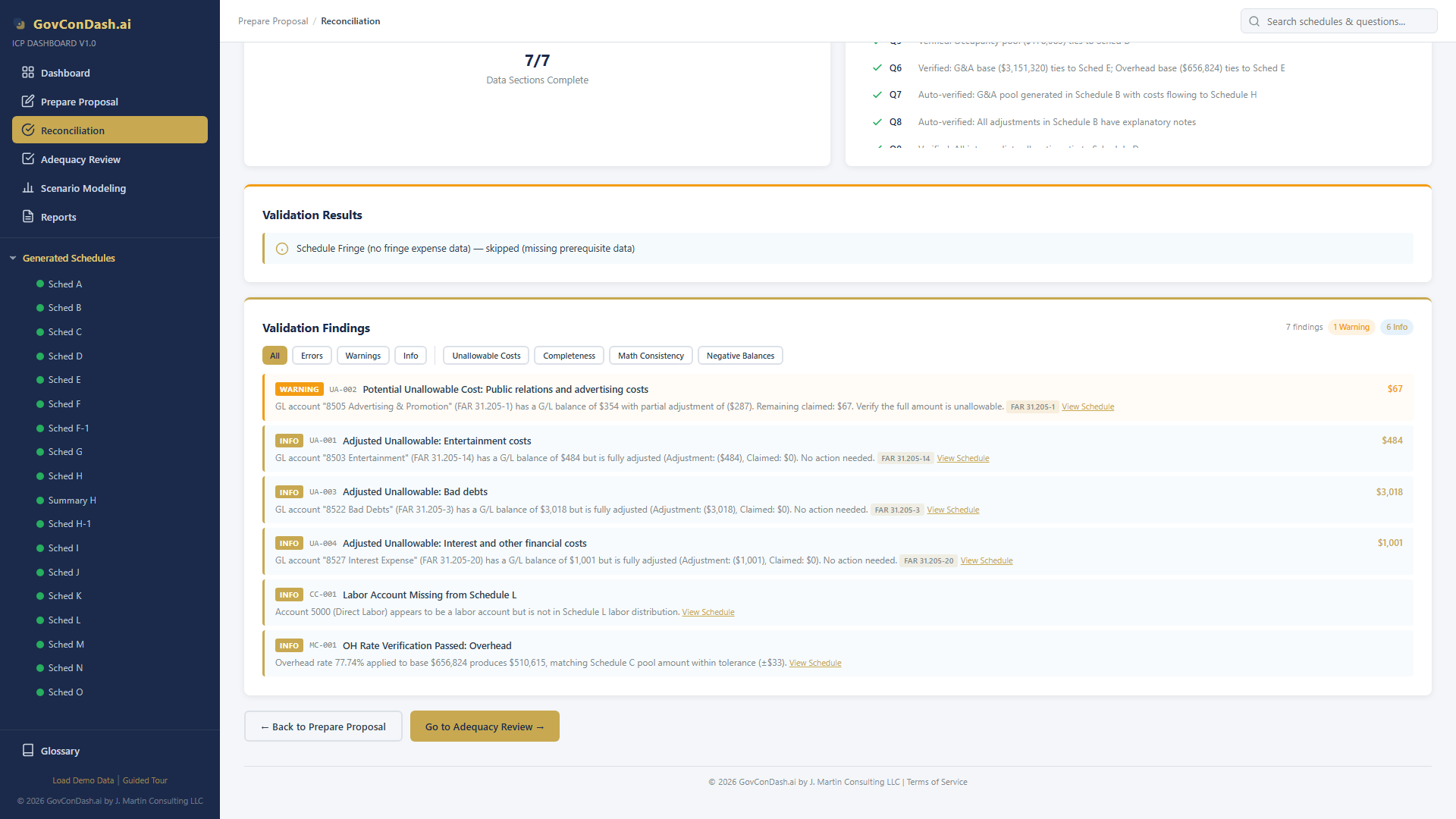
Smart Validation - FAR 31.205 unallowable cost detection

Smart Validation

FAR 31.205 • CAS 405

Scans for 21 FAR 31.205 unallowable cost categories with adjustment awareness. Flags partially adjusted accounts and cross-references Schedule B/C adjustments.

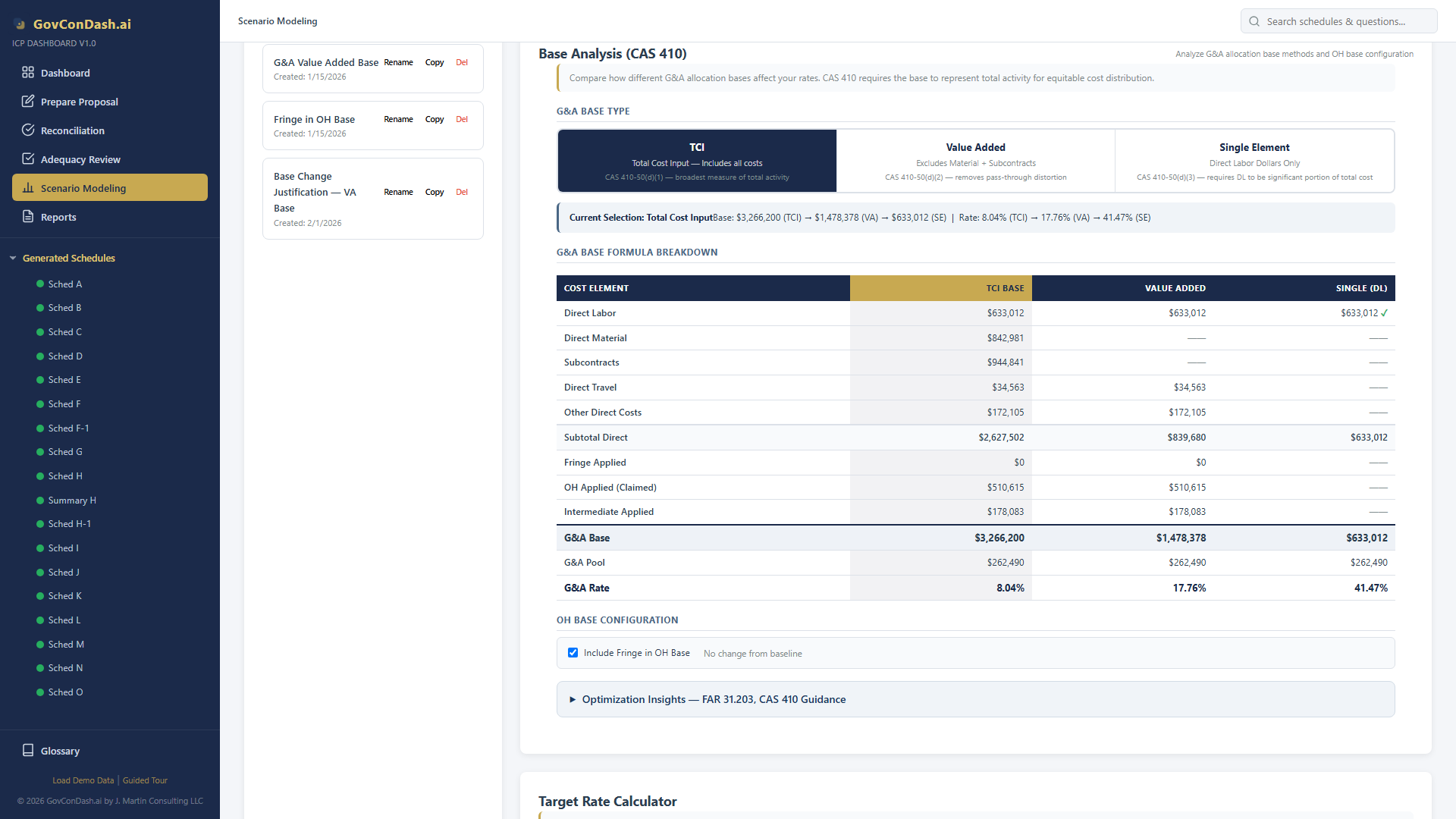
Scenario Modeling - CAS 410 base analysis

Scenario Modeling

CAS 410 • FAR 31.203

Models CAS 410 base changes (TCI, Value Added, Single Element) with G&A formula breakdowns, statistical regression justification, and rate impact analysis.

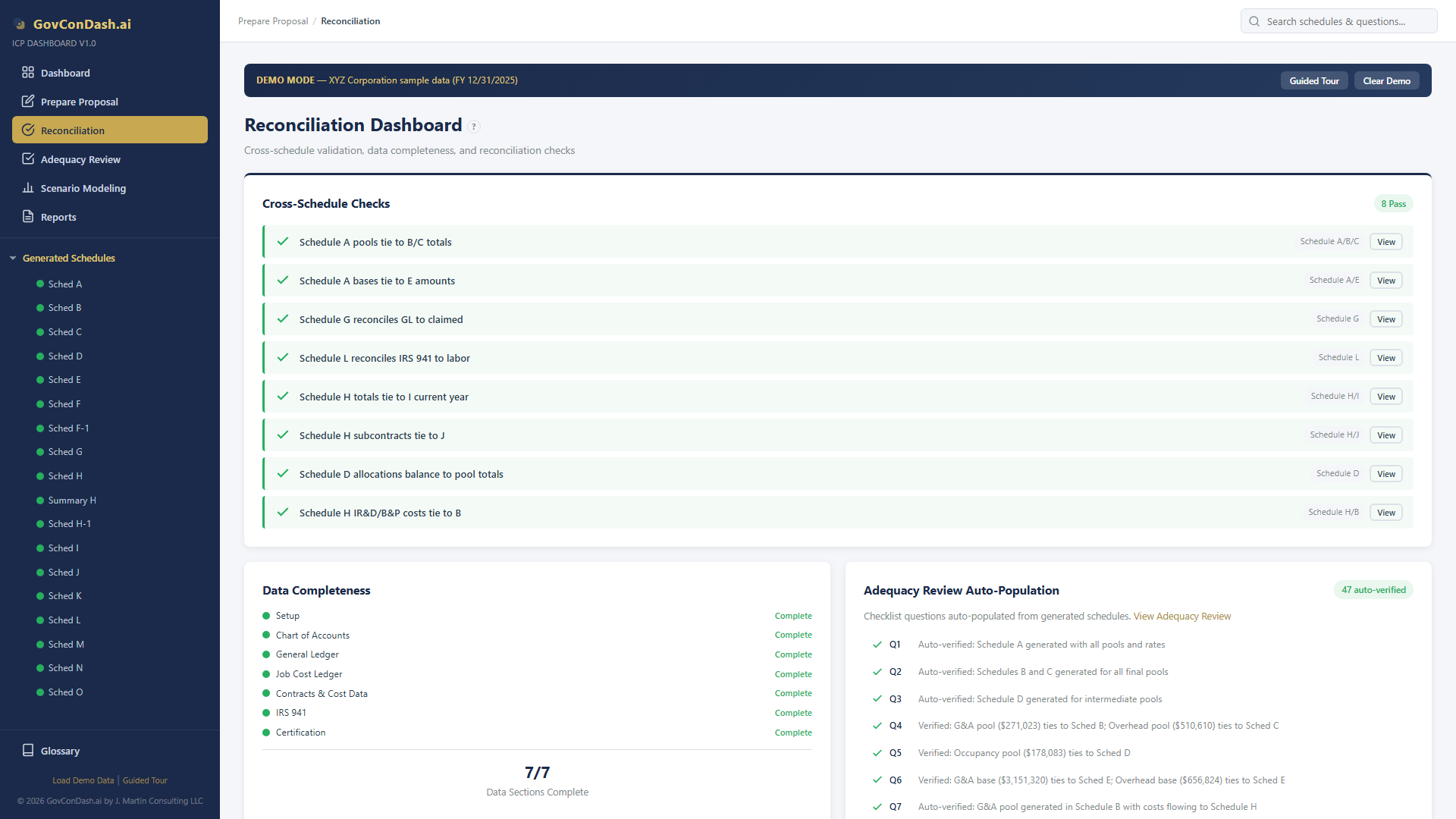
Reconciliation - cross-schedule consistency checks

Reconciliation

CAS 401 • FAR 31.201-1

Cross-checks schedules to $1 tolerance, enforcing CAS 401 consistency between accumulated and reported costs. Validates completeness and auto-populates adequacy items.

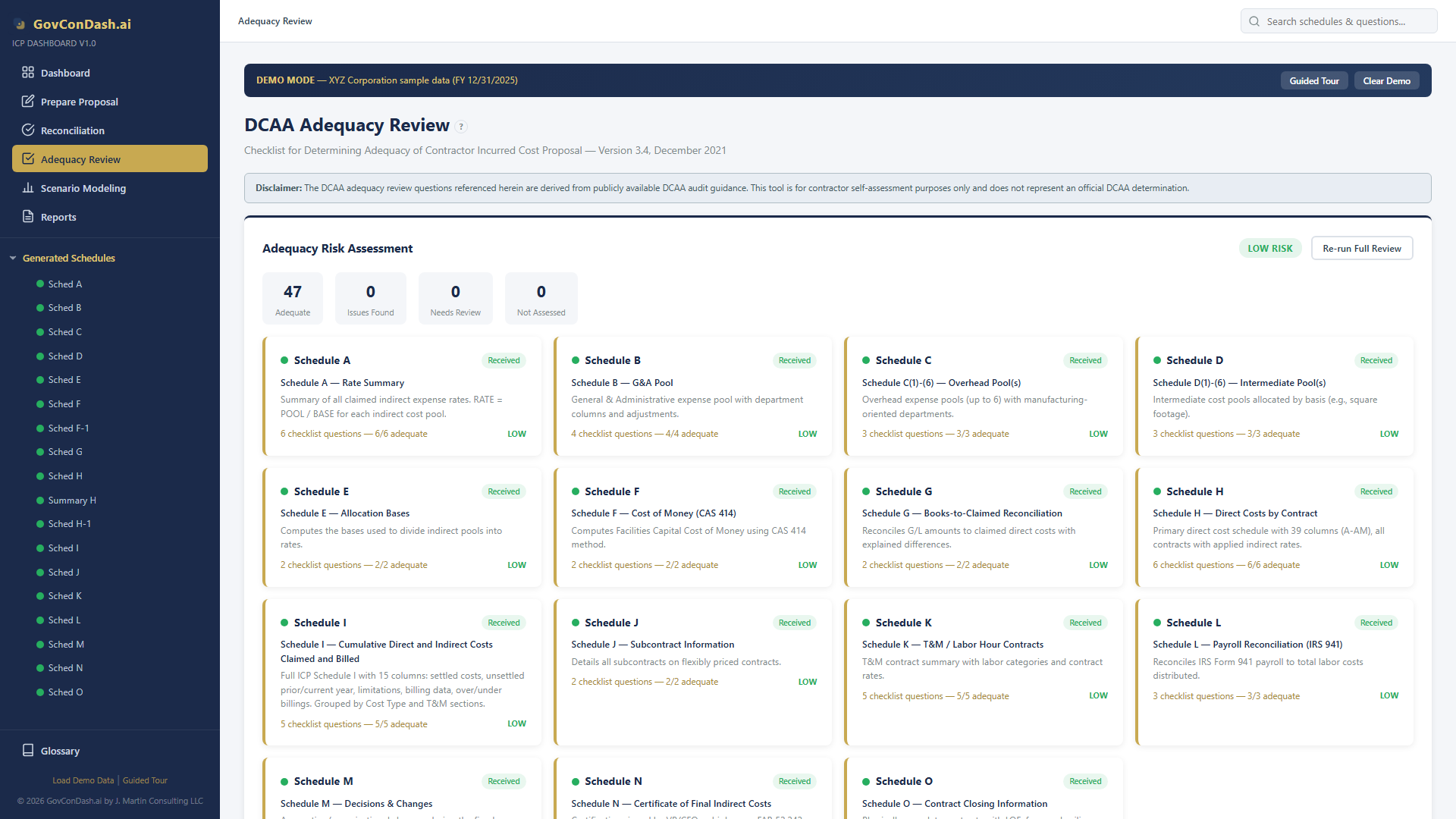
Adequacy Review - 47 DCAA checklist questions

Adequacy Review

DCAA Checklist v3.4 • 47 Questions

Maps all 47 DCAA adequacy checklist questions to the regulatory framework with risk scoring, auto-verification from generated schedules, and per-schedule assessment tracking.

Navigate FAR & CAS with Confidence

The ICP Dashboard embeds the complete FAR/CAS compliance framework into every schedule, validation check, and scenario analysis — so you can focus on optimization, not regulation hunting.

GovConDash.ai